


English



Paperback
₹2234
₹2304
3.04% OFF
(All inclusive*)
Delivery Options
Please enter pincode to check delivery time.
*COD & Shipping Charges may apply on certain items.
Review final details at checkout.
Looking to place a bulk order? SUBMIT DETAILS
Delivery Options
Please enter pincode to check delivery time.
*COD & Shipping Charges may apply on certain items.
Review final details at checkout.
About The Book
Description
Author(s)
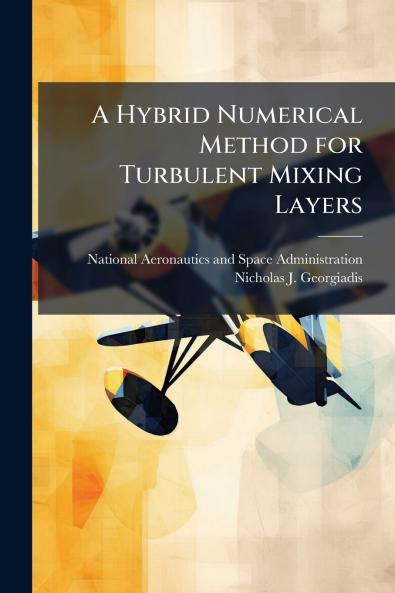
<p>A hybrid method has been developed for simulations of compressible turbulent mixing layers. Such mixing layers dominate the flows in exhaust systems of modern day aircraft and also those of hypersonic vehicles currently under development. The method configurations in which a dominant structural feature provides an unsteady mechanism to drive the turbulent development in the mixing layer. The hybrid method uses a Reynolds-averaged Navier-Stokes (RANS) procedure to calculate wall bounded regions entering a mixing section and a Large Eddy Simulation (LES) procedure to calculate the mixing dominated regions. A numerical technique was developed to enable the use of the hybrid RANS-LES method on stretched non-Cartesian grids. Closure for the RANS equations was obtained using the Cebeci-Smith algebraic turbulence model in conjunction with the wall-function approach of Ota and Goldberg. The wall-function approach enabled a continuous computational grid from the RANS regions to the LES region. The LES equations were closed using the Smagorinsky subgrid scale model. The hybrid RANS-LES method is applied to a benchmark compressible mixing layer experiment. Preliminary two dimensional calculations are used to investigate the effects of axial grid density and boundary conditions. Vortex shedding from the base region of a splitter plate separating the upstream flows was observed to eventually transition to turbulence. The location of the transition however was much further downstream than indicated by experiments. Actual LES calculations performed in three spatial directions also indicated vortex shedding but the transition to turbulence was found to occur much closer to the beginning of the mixing section. which is in agreement with experimental observations. These calculations demonstrated that LES simulations must be performed in three dimensions.</p><p>This work has been selected by scholars as being culturally important and is part of the knowledge base of civilization as we know it. This work was reproduced from the original artifact and remains as true to the original work as possible. Therefore you will see the original copyright references library stamps (as most of these works have been housed in our most important libraries around the world) and other notations in the work.</p><p>This work is in the public domain in the United States of America and possibly other nations. Within the United States you may freely copy and distribute this work as no entity (individual or corporate) has a copyright on the body of the work.</p><p>As a reproduction of a historical artifact this work may contain missing or blurred pages poor pictures errant marks etc. Scholars believe and we concur that this work is important enough to be preserved reproduced and made generally available to the public. We appreciate your support of the preservation process and thank you for being an important part of keeping this knowledge alive and relevant.</p>

Piracy-free

Assured Quality

Secure Transactions

Fast Delivery

Sustainably Printed
Details
ISBN 13
9781288915958
Publication Date
-13-03-2013
Pages
-238
Weight
-344 grams
Dimensions
-156x234x12.94 mm
