

English


Paperback
₹8122
(All inclusive*)
Delivery Options
Please enter pincode to check delivery time.
*COD & Shipping Charges may apply on certain items.
Review final details at checkout.
Looking to place a bulk order? SUBMIT DETAILS

Piracy-free

Assured Quality

Secure Transactions
About The Book
Description
Author
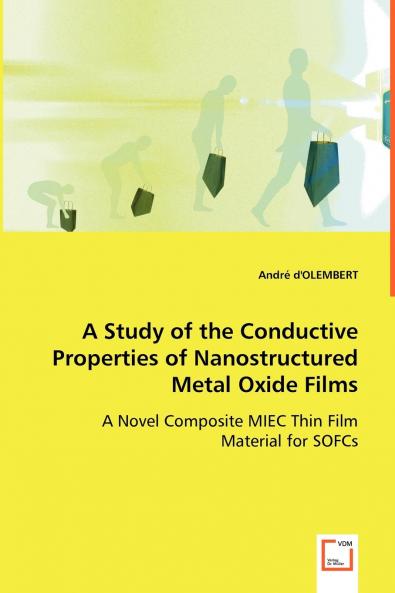
Fuel cells which were first employed in spacecraft are part of the ongoing pursuit for renewable energy sources and environmentally compatible electric power generation. Recent enhancements in design and materials might establish fuel cells in a sustainable hydrogen energy economy (SHEE) as viable alternatives to the internal combustion engine. This study investigates the conductive properties of metal-oxide thin films by developing a new deposition technique called dual channel ultrasonic spray pyrolysis (DC-USP). The DC-USP process has proved to be a reliable and cost-effective method to fabricate thin films. We have then created a novel mixed ionic electronic conductor (MIEC) composed of two metal-oxides: lanthanum strontium ferrite and copper-doped bismuth vanadate (LSF.40:BiCuVOx.10). This composite material can contribute to solve the major outstanding problem of the three-phase boundary (TPB) that limits the oxygen reduction reaction to within a microscopic region near the cathode-electrolyte interface in the SOFC device. Results show that at a temperature of 550 C the average bulk resistivity for LSF.40:BiCuVOx.10 films was 2.08 ohm-cm (a conductivity of 0.48 S/cm).
Piracy-free
Assured Quality
Secure Transactions
Delivery Options
Please enter pincode to check delivery time.
*COD & Shipping Charges may apply on certain items.
Review final details at checkout.
Details
ISBN 13
9783639034059
Publication Date
-03-07-2008
Pages
-344
Weight
-467 grams
Dimensions
-150x220x18.27 mm
