


English



Paperback
₹3384
₹3599
5.97% OFF
(All inclusive*)
Delivery Options
Please enter pincode to check delivery time.
*COD & Shipping Charges may apply on certain items.
Review final details at checkout.
Looking to place a bulk order? SUBMIT DETAILS

Piracy-free

Assured Quality

Secure Transactions
About The Book
Description
Author
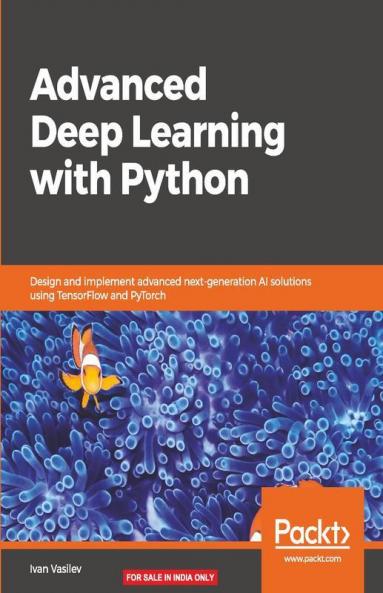
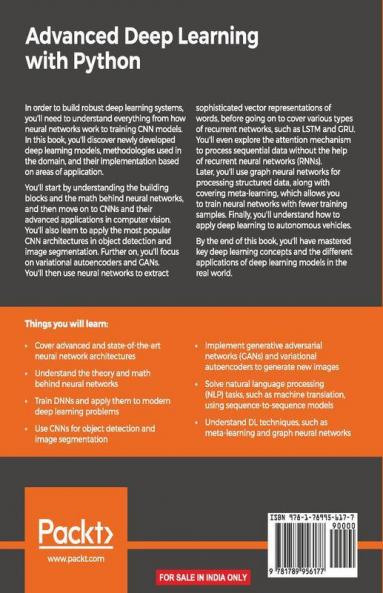
Gain expertise in advanced deep learning domains such as neural networks meta-learning graph neural networks and memory augmented neural networks using the Python ecosystemKey FeaturesGet to grips with building faster and more robust deep learning architecturesInvestigate and train convolutional neural network (CNN) models with GPU-accelerated libraries such as TensorFlow and PyTorchApply deep neural networks (DNNs) to computer vision problems NLP and GANsBook DescriptionIn order to build robust deep learning systems you’ll need to understand everything from how neural networks work to training CNN models. In this book you’ll discover newly developed deep learning models methodologies used in the domain and their implementation based on areas of application.You’ll start by understanding the building blocks and the math behind neural networks and then move on to CNNs and their advanced applications in computer vision. You'll also learn to apply the most popular CNN architectures in object detection and image segmentation. Further on you’ll focus on variational autoencoders and GANs. You’ll then use neural networks to extract sophisticated vector representations of words before going on to cover various types of recurrent networks such as LSTM and GRU. You’ll even explore the attention mechanism to process sequential data without the help of recurrent neural networks (RNNs). Later you’ll use graph neural networks for processing structured data along with covering meta-learning which allows you to train neural networks with fewer training samples. Finally you’ll understand how to apply deep learning to autonomous vehicles.By the end of this book you’ll have mastered key deep learning concepts and the different applications of deep learning models in the real world.What you will learnCover advanced and state-of-the-art neural network architecturesUnderstand the theory and math behind neural networksTrain DNNs and apply them to modern deep learning problemsUse CNNs for object detection and image segmentationImplement generative adversarial networks (GANs) and variational autoencoders to generate new imagesSolve natural language processing (NLP) tasks such as machine translation using sequence-to-sequence modelsUnderstand DL techniques such as meta-learning and graph neural networksWho this book is forThis book is for data scientists deep learning engineers and researchers and AI developers who want to further their knowledge of deep learning and build innovative and unique deep learning projects. Anyone looking to get to grips with advanced use cases and methodologies adopted in the deep learning domain using real-world examples will also find this book useful. Basic understanding of deep learning concepts and working knowledge of the Python programming language is assumed. About the Author Ivan Vasilev started working on the first open source Java Deep Learning library with GPU support in 2013. The library was acquired by a German company where he continued its development. He has also worked as a machine learning engineer and researcher in the area of medical image classification and segmentation with deep neural networks. Since 2017 he has focused on financial machine learning. He is working on a Python open source algorithmic trading library which provides the infrastructure to experiment with different ML algorithms. The author holds an MSc degree in Artificial Intelligence from The University of Sofia St. Kliment Ohridski.
Piracy-free
Assured Quality
Secure Transactions
Delivery Options
Please enter pincode to check delivery time.
*COD & Shipping Charges may apply on certain items.
Review final details at checkout.
Details
ISBN 13
9781789956177
Publication Date
-12-12-2019
Pages
-468
Weight
-811 grams
Dimensions
-191x235x24.64 mm
