



English



Paperback
₹1540
₹1796
14.25% OFF
(All inclusive*)
Delivery Options
Please enter pincode to check delivery time.
*COD & Shipping Charges may apply on certain items.
Review final details at checkout.
Looking to place a bulk order? SUBMIT DETAILS

Piracy-free

Assured Quality

Secure Transactions
About The Book
Description
Author
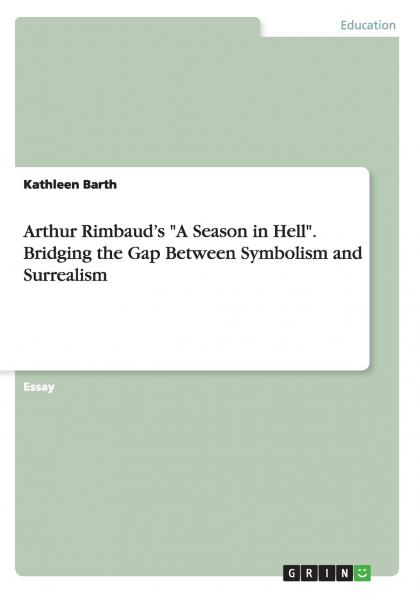
Essay from the year 2015 in the subject Didactics - French - Literature Works grade: A 99.0 course: ENGH 302 Advanced Composition language: English abstract: A chronicle of the symbolists'' influence over Rimbaud''s early poetry and how he laid the foundation for Surrealism with his exploration of the unconscious in A Season in Hell. As a young poet Arthur Rimbaud expressed a keen desire of becoming a seer: one who forecasts the future through supernatural insight. Throughout his career he sought visionary status by pushing the boundaries of poetic expression with his efforts of materializing the supernatural in his poetry. Rimbaud began fulfilling his goal by studying the work of the symbolists and incorporating their revolutionary modes of expression into his own poetry. Yet Rimbaud pushed the boundaries of poetic expression even further with his efforts to penetrate the deepest layers of the mind. By 1873 Rimbaud began exploring the mysterious realm of the unconscious through his own method of psychoanalysis a popular subject of Surrealism: a movement that entered the literary scene nearly four decades after the French Symbolists. Rimbaud portrays his unconscious thoughts and memories in A Season in Hell with the style he adapted from studying the symbolists. By composing A Season in Hell with the stylistic elements of Symbolism and the psychoanalytical focus that dominated Surrealism Rimbaud bridges the gap between both poetic movements
Piracy-free
Assured Quality
Secure Transactions
Delivery Options
Please enter pincode to check delivery time.
*COD & Shipping Charges may apply on certain items.
Review final details at checkout.
Details
ISBN 13
9783656975670
Publication Date
-25-06-2015
Pages
-20
Weight
-39 grams
Dimensions
-148x210x1.22 mm
