


English



₹14180
₹18680
24.09% OFF
(All inclusive*)
Hardback
Delivery Options
Please enter pincode to check delivery time.
*COD & Shipping Charges may apply on certain items.
Review final details at checkout.
Looking to place a bulk order? SUBMIT DETAILS
Delivery Options
Please enter pincode to check delivery time.
*COD & Shipping Charges may apply on certain items.
Review final details at checkout.
About The Book
Description
Author
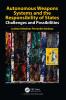
<p>This book reviews whether the existing framework in place can effectively address breaches in the context of Autonomous Weapons Systems (AWS). The work endeavors to map out the main gaps and some possible approaches to address them. Part I sets the ground. First it provides a concept of AWS. Next it discusses the accountability gap AWS generate and shows how the international community has put far more emphasis on individual responsibility rather than state responsibility. Part II analyzes the challenges AWS pose to the regime governing state responsibility under international law as codified in the Draft Articles on State Responsibility (ARSIWA). In this regard it discusses attribution breach of an international obligation <i>tempus comissi delicti</i> multiple states involved in a breach <i>force majeure</i> assurance of non-repetition issues related to damage the human-machine interaction and its impacts on state´s responsibility responsibility for not using AWS weapons review and the duty of due diligence. Part III summarizes the challenges discussed in part II in thirteen issues of concern and presents possible paths <i>de lege ferenda</i> to address each of those issues mainly a paradigm shift in attribution and strict liability among seven other more specific proposals. The conclusion reached is that the current regime on the international responsibility of states is insufficient to deal with the new challenges AWS pose. <i>De lege ferenda</i> the book argues for following the paths suggested in part III. It also reflects on parts II and III's findings and how many of AWS's challenges to state´s responsibility apply to other autonomous devices. Therefore through the case study of AWS this work also opens the broader discussion of the gaps in the international responsibility of states regarding autonomous device misdoings.</p>

Piracy-free

Assured Quality

Secure Transactions

Fast Delivery

Sustainably Printed
Details
ISBN 13
9781032692326
Publication Date
-18-10-2024
Pages
-256
Weight
-461 grams
Dimensions
-155.96x233.93x15.15 mm
