

English


₹2584
(All inclusive*)
Paperback
Delivery Options
Please enter pincode to check delivery time.
*COD & Shipping Charges may apply on certain items.
Review final details at checkout.
Looking to place a bulk order? SUBMIT DETAILS
Delivery Options
Please enter pincode to check delivery time.
*COD & Shipping Charges may apply on certain items.
Review final details at checkout.
About The Book
Description
Author
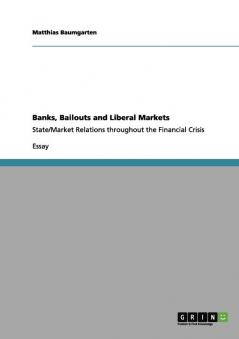
Essay from the year 2011 in the subject Economics - International Economic Relations grade: 10 (78 %) University of Warwick (Politics and International Studies) course: International Political Economy language: English abstract: The power and instability of the financial system fuelled by decades of deregulationand liberalization have been demonstrated impressively by the current financialcrisis. Some commentators see in this system a disembedding of society and markets predicting a new Polanyian 'double movement' that returns power to the state. However the idea of the 'powerless state' is not applicable as states consciously embedded their citizens in the financial markets in order to shift social welfare responsibilities to individual asset-owners. This gave financial markets control over financial dynamics which was used to create profits through innovation and disproportionate risk-taking. As a consequence small changes in financial variables caused the international financial crisis and governments felt compelled to bailout overleveraged financial institutions deemed 'too big to fail'. Hyman Minsky described many of these developments in his 'financial instability hypothesis'. As bailouts are only temporary measures to uphold the status quo he calls for increased state control over the financial markets in order to prevent excessive speculation in the future. Many regulatory proposals created following the onset of the crisis echoed this demand envisioning a paradigmatic shift that could reverse the trend of deregulation in pre-crisis years. However the reliance of the state on the financialsector to support the system of 'asset-based welfare' proved to be resilient enough to withstand the initial crisis. Now signs of recovery create new priorities that displace demands for financial regulation. The financial markets thus retain their central position albeit with a few self-regulatory obligations and a change in state/market relations is

Piracy-free

Assured Quality

Secure Transactions

Fast Delivery

Sustainably Printed
Details
ISBN 13
9783656114161
Publication Date
-04-02-2012
Pages
-56
Weight
-81 grams
Dimensions
-148x210x3.41 mm
