


English


Paperback
₹5090
₹6141
17.11% OFF
(All inclusive*)
Delivery Options
Please enter pincode to check delivery time.
*COD & Shipping Charges may apply on certain items.
Review final details at checkout.
Looking to place a bulk order? SUBMIT DETAILS

Piracy-free

Assured Quality

Secure Transactions
About The Book
Description
Author(s)
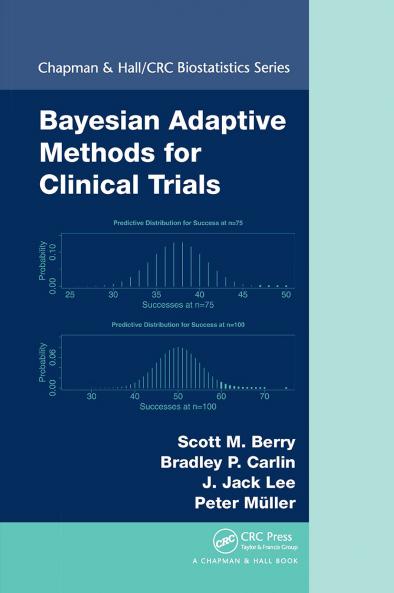
<p>Already popular in the analysis of medical device trials adaptive Bayesian designs are increasingly being used in drug development for a wide variety of diseases and conditions from Alzheimer’s disease and multiple sclerosis to obesity diabetes hepatitis C and HIV. Written by leading pioneers of Bayesian clinical trial designs <strong>Bayesian Adaptive Methods for Clinical Trials</strong> explores the growing role of Bayesian thinking in the rapidly changing world of clinical trial analysis.</p><p>The book first summarizes the current state of clinical trial design and analysis and introduces the main ideas and potential benefits of a Bayesian alternative. It then gives an overview of basic Bayesian methodological and computational tools needed for Bayesian clinical trials. With a focus on Bayesian designs that achieve good power and Type I error the next chapters present Bayesian tools useful in early (Phase I) and middle (Phase II) clinical trials as well as two recent Bayesian adaptive Phase II studies: the BATTLE and ISPY-2 trials. In the following chapter on late (Phase III) studies the authors emphasize modern adaptive methods and seamless Phase II–III trials for maximizing information usage and minimizing trial duration. They also describe a case study of a recently approved medical device to treat atrial fibrillation. The concluding chapter covers key special topics such as the proper use of historical data equivalence studies and subgroup analysis.</p><p>For readers involved in clinical trials research this book significantly updates and expands their statistical toolkits. The authors provide many detailed examples drawing on real data sets. The R and WinBUGS codes used throughout are available on supporting websites.</p><p>Scott Berry talks about the book on the <a href=http://www.youtube.com/watch?v=qkpDCHAErlI>CRC Press YouTube Channel</a>.</p>
Piracy-free
Assured Quality
Secure Transactions
Delivery Options
Please enter pincode to check delivery time.
*COD & Shipping Charges may apply on certain items.
Review final details at checkout.
Details
ISBN 13
9781032922058
Publication Date
-14-10-2024
Pages
-324
Weight
-551 grams
Dimensions
-156x234x17.37 mm
