

English


₹1791
₹1854
3.4% OFF
(All inclusive*)
Paperback
Delivery Options
Please enter pincode to check delivery time.
*COD & Shipping Charges may apply on certain items.
Review final details at checkout.
Looking to place a bulk order? SUBMIT DETAILS
Delivery Options
Please enter pincode to check delivery time.
*COD & Shipping Charges may apply on certain items.
Review final details at checkout.
About The Book
Description
Author
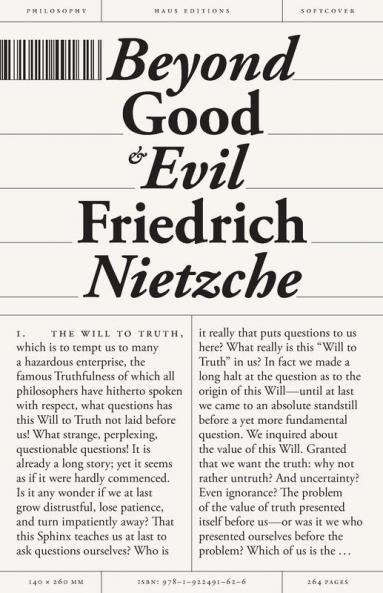
<p><strong>Fired with a fearless iconoclasm which surpassed the wildest dreams of contemporary free thought - <em>The New York Times</em>&nbsp;</strong></p><p><em>Beyond Good and Evil </em>is one of the most scathing and powerful critiques of philosophy religion science politics and ethics ever written - an essential summary of Friedrich Nietzsche's philosophy.&nbsp;</p><p>One of the most iconoclastic philosophers of all time Nietzsche dramatically rejected notions of good and evil truth and God. <em>Beyond Good and Evil</em> is one of the most remarkable and influential books of the nineteenth century.&nbsp;</p><p><em>Beyond Good and Evil</em> represents Nietzsche's attempt to sum up his philosophy. It demonstrates that the world is steeped in false piety and infected with a 'slave morality'. With wit and subversive energy Nietzsche demands that the individual impose their own 'will to power' upon the world.</p><p>In nine parts the book is designed to give the reader a comprehensive idea of Nietzsche's thought and style: they span The Prejudices of Philsophers The Free Spirit religion morals scholarship Our Virtues Peoples and Fatherlands and What Is Noble as well as epigrams and a concluding poem.</p><p>He who fights with monsters should be careful lest he thereby become a monster. And if thou gaze long into an abyss the abyss will also gaze into thee.- Friedrich Nietzsche</p><p><strong>About the Author</strong></p><p>Friedrich Nietzsche (1844-1900) German classical scholar philosopher and critic of culture who became one of the most influential of all modern thinkers. His attempts to unmask the motives that underlie traditional Western religion morality and philosophy deeply affected generations of theologians philosophers psychologists poets novelists and playwrights. He thought through the consequences of the triumph of the Enlightenment's secularism expressed in his observation that God is dead in a way that determined the agenda for many of Europe's most-celebrated intellectuals after his death. He was an ardent foe of nationalism anti-Semitism and power politics.&nbsp;</p><p>Nietzsche once wrote that some men are born posthumously and that is certainly true in his case. The history of philosophy theology and psychology since the early 20th century is unintelligible without him. Nietzsche's great influence is due not only to his originality but also to the fact that he was one of the German language's most-brilliant prose writers.</p>

Piracy-free

Assured Quality

Secure Transactions

Fast Delivery

Sustainably Printed
Details
ISBN 13
9781922491626
Publication Date
-01-12-2023
Pages
-264
Weight
-315 grams
Dimensions
-140x216x16.75 mm
