

English


Hardback
₹3230
₹3524
8.34% OFF
(All inclusive*)
Delivery Options
Please enter pincode to check delivery time.
*COD & Shipping Charges may apply on certain items.
Review final details at checkout.
Looking to place a bulk order? SUBMIT DETAILS

Piracy-free

Assured Quality

Secure Transactions
About The Book
Description
Author
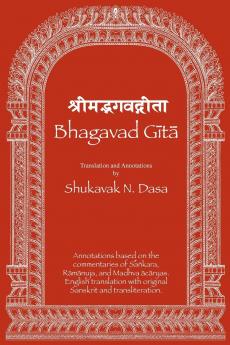
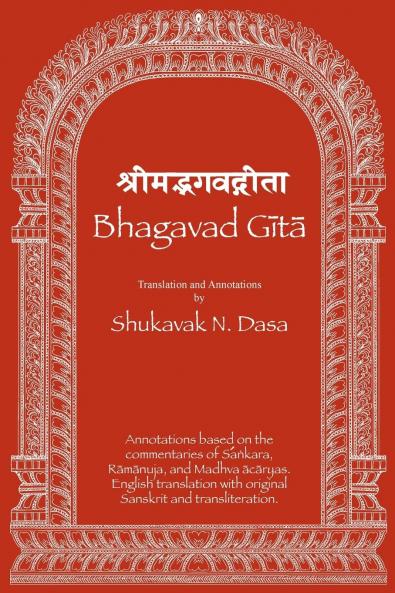
<p>Three classical interpreters of Bhagavad Gītā: Śaṅkara Rāmānuja and Madhva ācāryas have so influenced the course of Hindu thought that a modern student who reads the Gītā with an eye to these three commentators will have obtained a balanced exposure to the theological expanse of the work.</p><p>It is the nature and beauty of the Sanskrit language that it invites multiple interpretations. Dr. Shukavak's solution to this problem has been to utilize a system of annotation in the form of footnotes which allows him to make a particular translation and then to show an alternative translation or interpretation when it is appropriate. This system of annotation utilizes the commentaries of Śaṅkara Rāmānuja and Madhva ācāryas.</p><p>If you only read one book of Hindu scripture let that be Bhagavad Gītā. Even though it can be read in just a few sessions it captures the very essence of Hindu thought.</p><p>In the last two centuries hundreds of editions of Bhagavad Gītā have been published in various Western languages. Dr. Shukavak has translated the Bhagavad Gītā in a scholarly way but not so scholarly that the general reader will find it obscure. Moreover it is written from a perspective in which the Gītā appears as much more than a work of world-class literature but as a living religious text meant to inspire faith in the Divine.</p><p>In reading a religious work like Bhagavad Gītā it is all too easy to approach it with foreign concepts of religion in mind. If we live in the West we may unknowingly approach the Gītā with Christian Jewish or Islamic notions of God soul heaven hell and sin. We translate brahman as God ātman as soul pāpam as sin dharma as religion or duty. However brahman is not the same as God; ātman is not equivalent to the soul pāpam is not sin and dharma is much more than mere duty or religion.</p><p>A work like the Gītā therefore has to be translated and read on its own terms and not those of another religious tradition. Because the Hinduism now developing in the West is often reflected through the lenses of Christianity Judaism and Islam the theological uniqueness of Vedic religion is slowly being eroded. For these reasons there are certain Sanskrit terms in the Gītā that the translator has chosen not to translate into English. For example such terms as brahman dharma and yoga are left untranslated. The reader is thus urged to become comfortable with a lexicon that is essential to an understanding of the Gītā and Hinduism in general.</p><p><span style=background-color: rgba(255 255 255 1); color: rgba(83 90 98 1)>English translation with original Sanskrit and transliteration. Annotations based on the commentaries of Saṅkara Rāmānuja and Madhva ācāryas. Sanskrit Glossary Sanskrit Verse Index General Index Family Registry Introduction.</span></p>
Piracy-free
Assured Quality
Secure Transactions
Delivery Options
Please enter pincode to check delivery time.
*COD & Shipping Charges may apply on certain items.
Review final details at checkout.
Details
ISBN 13
9781889756349
Publication Date
-29-07-2024
Pages
-394
Weight
-620 grams
Dimensions
-152x229x22.23 mm
