

English


Paperback
₹5245
₹6277
16.44% OFF
(All inclusive*)
Delivery Options
Please enter pincode to check delivery time.
*COD & Shipping Charges may apply on certain items.
Review final details at checkout.
Looking to place a bulk order? SUBMIT DETAILS

Piracy-free

Assured Quality

Secure Transactions
About The Book
Description
Author
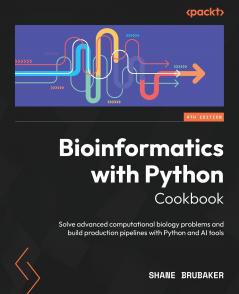
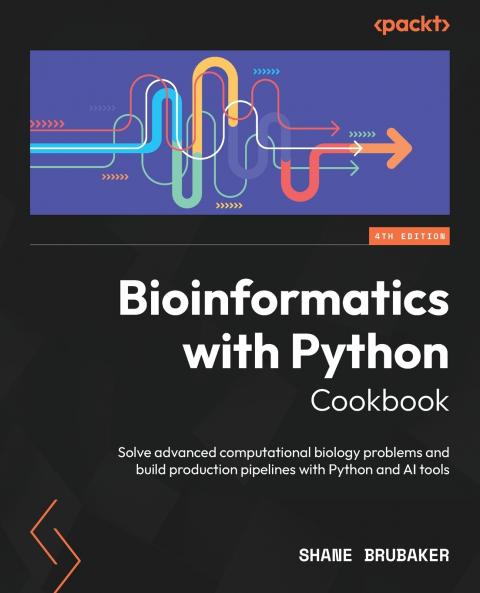
<p><strong>Enhance your bioinformatics toolbox with practical Python recipes tips and tricks for key tasks like aligning sequence data calling variants and building Infrastructure as Code</strong></p><p><strong>Key Features:</strong></p><p>- Perform sequence analysis at primary secondary and tertiary levels using Python libraries</p><p>- Solve real-world problems in the fields of phylogenetics protein design and annotation</p><p>- Use language models and other AI techniques to work with multimodal bioinformatics data</p><p>- Purchase of the print or Kindle book includes a free PDF eBook</p><p><strong>Book Description:</strong></p><p>If you've ever felt overwhelmed by the vast number of Python tools available for bioinformatics you're not alone. The Bioinformatics with Python Cookbook is a recipe-based guide that explores practical approaches for solving classic bioinformatics challenges showing you which Python packages work best for each task.</p><p>You'll start with the essential Python libraries for data science and bioinformatics then move through key workflows in sequencing analysis quality control alignment and variant calling. Along the way you'll pick up modern coding practices explore recent advances in bioinformatics research and gain hands-on experience with libraries such as NumPy pandas and sci-kit learn. This book walks you through core bioinformatics tasks such as phylogenetic analysis and population genomics while familiarizing you with the wealth of modern public bioinformatics databases. You'll learn cloud computing approaches used by researchers set up workflow orchestration systems for controlling bioinformatics pipelines and see how AI and the use of large language models (LLMs) are reshaping the field-right down to designing proteins and DNA.</p><p>By the end of this book you'll be ready to apply Python for real bioinformatics work and launch bioinformatics pipelines for your research.</p><p><strong>What You Will Learn:</strong></p><p>- Process analyze and align sequencing data</p><p>- Call variants and interpret their biological meaning</p><p>- Use modern cloud infrastructure to launch bioinformatics workflows</p><p>- Ingest clean and transform data efficiently</p><p>- Explore how AI is shaping the future of bioinformatics</p><p>- Leverage imaging data for biological insights</p><p>- Apply single-cell sequencing to cluster and compare gene expression</p><p><strong>Who this book is for:</strong></p><p>This book is for early- to mid-level practitioners in bioinformatics data science and software engineering who want to improve their skills and apply practical solutions to real-world problems. You should have a basic understanding of biology including DNA proteins and cell structure as well as Python programming and software engineering techniques. While prior exposure to machine learning with Python is not essential experience with a cloud computing platform (AWS GCP or Azure) will be helpful.</p><p><strong>Table of Contents</strong></p><p>- Computer Specifications and Python Setup</p><p>- Basics of Data Manipulation</p><p>- Modern Coding Practices and AI-Generated Coding</p><p>- Data Science and Graphing</p><p>- Alignment and Variant Calling</p><p>- Annotation and Biological Interpretation</p><p>- Genomes and Genome Assembly</p><p>- Accessing Public Databases</p><p>- Protein Structure and Proteomics</p><p>- Phylogenetics</p><p>- Population Genetics</p><p>- Metabolic Modeling and Other Applications</p><p>- Genome Editing</p><p>- Cloud Basics</p><p>- Workflow Systems</p><p>- More Workflow Systems</p><p>- Deep Learning and LLMs for Nucleic Acid and Protein Design</p><p>- Single-Cell Technology and Imaging</p>
Piracy-free
Assured Quality
Secure Transactions
Delivery Options
Please enter pincode to check delivery time.
*COD & Shipping Charges may apply on certain items.
Review final details at checkout.
Details
ISBN 13
9781836642756
Publication Date
-19-12-2025
Pages
-618
Weight
-1064 grams
Dimensions
-191x235x31.66 mm
