

English


Hardback
₹3793
₹3843
1.3% OFF
(All inclusive*)
Delivery Options
Please enter pincode to check delivery time.
*COD & Shipping Charges may apply on certain items.
Review final details at checkout.
Looking to place a bulk order? SUBMIT DETAILS
Delivery Options
Please enter pincode to check delivery time.
*COD & Shipping Charges may apply on certain items.
Review final details at checkout.
About The Book
Description
Author
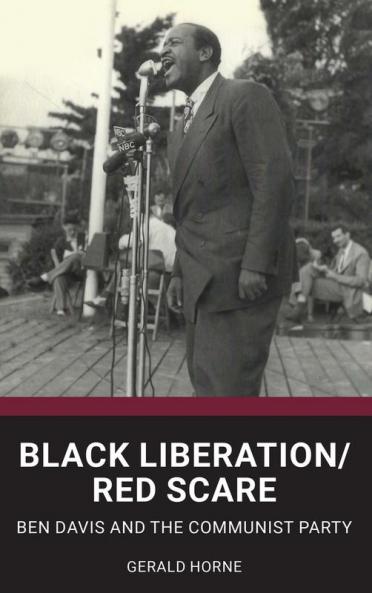
<p>Black Liberation/Red Scare is a study of an African American Communist leader </p><p>Ben Davis Jr. (1904-64). Though it examines the numerous grassroots campaigns </p><p>that he was involved in it is first and foremost a study of the man and secondarily a </p><p>study of the Communist party from the 1930s to the 1960s. By examining the public </p><p>life of an important party leader Gerald Horne uniquely approaches the story of how </p><p>and why the party rose and fell.</p><p>&nbsp;</p><p>Ben Davis Jr. was the son of a prominent Atlanta publisher and businessman who </p><p>was also the top African American leader of the Republican party until the onset of </p><p>the Great Depression. Davis was trained for the black elite at Morehouse Amherst </p><p>and Harvard Law School. After graduating from Harvard he joined the Communist </p><p>party where he remained as one of its most visible leaders for thirty years. In 1943 </p><p>after being endorsed by his predecessor Adam Clayton Powell Jr. he was elected to </p><p>the New York City Council from Harlem and subsequently reelected by a larger </p><p>margin in 1945. Davis received support from such community figures as NAACP </p><p>leader Roy Wilkins boxer Joe Louis and musician Duke Ellington. While on the </p><p>council Davis fought for rent control and progressive taxation and struggled against </p><p>transit fare hikes and police brutality.</p><p>&nbsp;</p><p>With the onset of the Red Scare and the Cold War Davis-like the Communist party itself</p><p>was marginalized. The Cold War made it difficult for the U.S. to compete with Moscow for</p><p>the hearts and minds of African Americans while they were subjected to third-class</p><p>citizenship at home. Yet in return for civil rights concessions African American organizations</p><p>such as the NAACP were forced to distance themselves from figures such as Ben Davis. In</p><p>1949 he was ousted unceremoniously (and perhaps illegally from the City Council. He was</p><p>put on trial jailed in 1951 and not released until 1956 when the civil rights movement was</p><p>gathering momentum. His friendship with the King family based upon family ties in Atlanta</p><p>was the ostensible cause for the FBI surveillance of Dr. Martin Luther King Jr.</p><p>COINTEL-PRO the counterintelligence program of the FBI which was aimed initially at</p><p>the CPUSA made sure to keep a close eye on Davis as well. But when the civil rights</p><p>movement reached full strength in the 1960s Davis's controversial appearances at college</p><p>campuses helped to set the stage for a new era of activism at universities.</p><p>Davis died in 1964. According to Horne the time has now come when he along with </p><p>his good friend Paul Robeson and W. E. B. DuBois should be regarded as a premier leader </p><p>of African- Americans and the U.S. Left during the twentieth century<strong>.</strong></p><p><br></p>

Piracy-free

Assured Quality

Secure Transactions

Fast Delivery

Sustainably Printed
Details
ISBN 13
9780717808915
Publication Date
-12-03-2021
Pages
-460
Weight
-706 grams
Dimensions
-152x229x30.16 mm
