

English


Paperback
₹1688
(All inclusive*)
Delivery Options
Please enter pincode to check delivery time.
*COD & Shipping Charges may apply on certain items.
Review final details at checkout.
Looking to place a bulk order? SUBMIT DETAILS
Delivery Options
Please enter pincode to check delivery time.
*COD & Shipping Charges may apply on certain items.
Review final details at checkout.
About The Book
Description
Author(s)
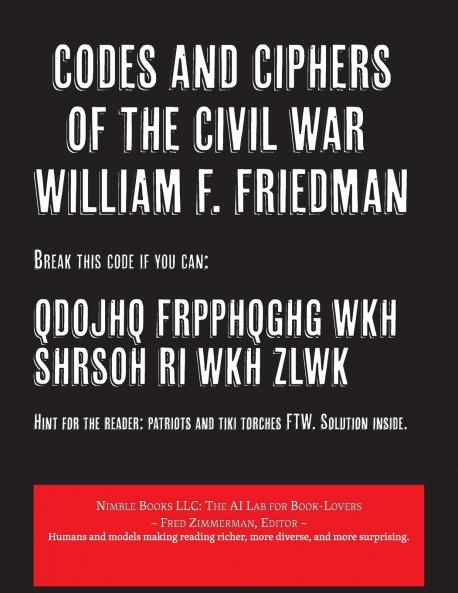
<p><span style=color: rgba(230 0 0 1)>Break this code:</span></p><p><br></p><p><span style=color: rgba(230 0 0 1)>QDOJHQ FRPPHQGHG WKH SHRSOH RI </span></p><p><span style=color: rgba(230 0 0 1)> WKH ZLWK</span></p><p><br></p><p><em style=color: rgba(230 0 0 1)>Hint for the reader: patriots and tiki torches FTW. </em><span style=color: rgba(230 0 0 1)>Solution inside.</span></p><p><br></p><p>This famous lecture by William F. Friedman the father of American cryptography provides a fascinating glimpse into the world of cryptology during the American Civil War examining the systems used by both Union and Confederate forces.</p><p>Key Points:</p><ol><li><span contenteditable=false></span><strong>Albert J. Myer and the Signal Corps:</strong> The lecture details Myer's development of the wig-wag system of visual signaling and the subsequent establishment of the Signal Corps. The initial lack of electrical telegraphy capabilities and the ensuing rivalry with the U.S. Military Telegraph Corps (USMTC) created significant challenges for the Signal Corps.</li><li><span contenteditable=false></span><strong>Union Cryptosystems:</strong> The lecture describes the two primary cryptosystems used by the Union:</li><li><span contenteditable=false></span><strong>Myer's Cipher Disk</strong>: Employed by the Signal Corps for tactical communications this disk allowed for changing the visual signal equivalents for letters offering a basic level of encryption.</li><li><span contenteditable=false></span>Route Ciphers: Utilized by the USMTC for strategic communications these ciphers involved transposing words within a matrix offering a more complex level of encryption compared to the Myer disk.</li><li><span contenteditable=false></span><strong>Confederate Cryptosystems:</strong> The lecture explains the Confederate reliance on the Vigenère cipher also known as the court cipher for both tactical and strategic communications. This system used a keyword to shift alphabets cyclically providing a polyalphabetic encryption method.</li><li><span contenteditable=false></span><strong>Weaknesses of the Systems:</strong> The lecture critically examines the weaknesses of both Union and Confederate cryptosystems:</li><li><span contenteditable=false></span><strong>Myer's Cipher Disk:</strong> Susceptible to cryptanalysis due to its monoalphabetic nature.</li><li><span contenteditable=false></span><strong>Route Ciphers:</strong> Vulnerable if codebooks were captured and the limited number of code words reduced their effectiveness.</li><li><span contenteditable=false></span><strong>Confederate Vigenère Ciphers:</strong> Leaving words unenciphered and revealing word lengths through the cipher text compromised security. Additionally the limited number of keys used during the war made them susceptible to cryptanalysis.</li></ol><p>Additional Observations:</p><ol><li><span contenteditable=false></span>The lecture highlights the importance of cryptology in warfare emphasizing its role in secure communication and the impact of insecure communications on the outcome of battles and campaigns.</li><li><span contenteditable=false></span>It reveals the lack of advanced cryptographic knowledge during the Civil War era with both sides relying on relatively simple systems that were often vulnerable to cryptanalysis.</li><li><span contenteditable=false></span>The lecture raises interesting questions about the effectiveness of the Union and Confederate cryptosystems and the potential impact of their weaknesses on the course of the war.</li></ol><p><br></p><p>Overall the lecture provides a valuable introduction to the fascinating world of Civil War cryptology and offers insights into the evolution of secure communications in warfare.</p>

Piracy-free

Assured Quality

Secure Transactions

Fast Delivery

Sustainably Printed
Details
ISBN 13
9781608883035
Publication Date
-21-05-2024
Pages
-20
Weight
-75 grams
Dimensions
-216x280x1.05 mm
