


This Book is Out of Stock!
English



Hardback
₹7072
₹8075
12.42% OFF
(All inclusive*)
Delivery Options
*COD & Shipping Charges may apply on certain items.
Review final details at checkout.
Looking to place a bulk order? SUBMIT DETAILS

Piracy-free

Assured Quality

Secure Transactions
About The Book
Description
Author(s)
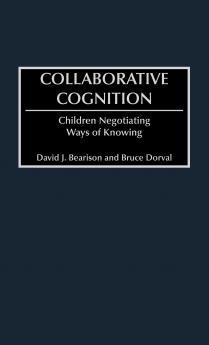
Human cognition increasingly is coming to be understood and studied as something that does not necessarily reside within individuals but rather as something that evolves through interpersonal communication. Using the interpersonal event as the unit of analysis the authors of Collaborative Cognition examine how children interactively co-construct knowledge and ways of knowing in social contexts. In an illustration of the idea that thinking is as much interactive as self-reflective--one that supports the cognitive developmental theories of Jean Piaget and Lev Vygotsky--this important new study examines the social origins of thought and the inherently discursive nature of thinking itself.The social context in question was created by the authors who showed to pairs of children a variety of game materials and asked them to collaborate on creating a board game. Negotiating the co-construction of a game back and forth turn by turn enabled the children to construct jointly a series of mutually obligatory goals and rules that sequentially defined the evolution of increasingly more complex modes of play. This innovative use of sequential analyses to study evolving streams of conversation discourse represents a fully process-oriented rather than outcome-oriented approach to studying cognitive development.
Piracy-free
Assured Quality
Secure Transactions
*COD & Shipping Charges may apply on certain items.
Review final details at checkout.
₹7072
₹8075
12% OFF
Hardback
Out Of Stock
All inclusive*
Details
ISBN 13
9781567506570
Publication Date
-30-11-2001
Pages
-188
Weight
-305 grams
Dimensions
-140x216x14.29 mm
