


This Book is Out of Stock!
English



Hardback
₹23730
(All inclusive*)
Delivery Options
*COD & Shipping Charges may apply on certain items.
Review final details at checkout.
Looking to place a bulk order? SUBMIT DETAILS
*COD & Shipping Charges may apply on certain items.
Review final details at checkout.
₹23730
Out Of Stock
All inclusive*
About The Book
Description
Author(s)
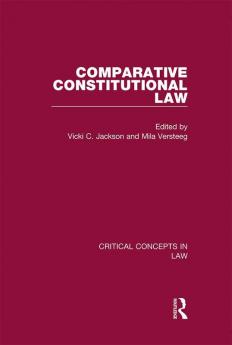
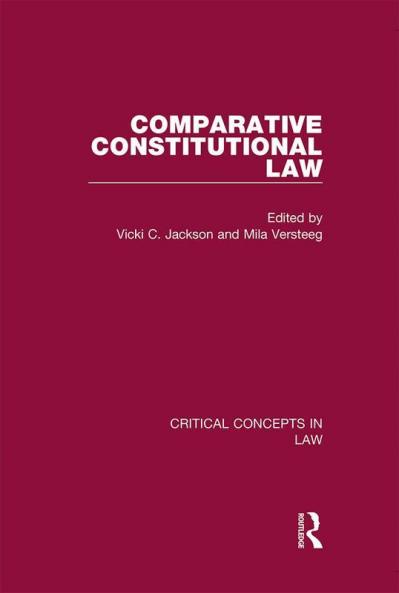
<p>This new 4 volume collection meets the need for an authoritative reference work to help researchers and students navigate and make better sense of an abundance of scholarship in comparative constitutional law. Topics include constitution-making and amendment; the different structural components of constitutional governance; the interaction of constitutional law with transnational sources of law; and theoretical and practical aspects of constitutional legitimacy.</p> <p>Volume I:</p><p>Constitutions and Constitutionalism </p><p>Part 1. Why a Constitution?</p><p>1. Cass R. Sunstein, extract from ‘Constitutionalism and Secession’, <i>University of Chicago Law Review</i>, 58, 2, 1991, 636-643.</p><p>2. Jon Elster, extract from ‘Ulysses Unbound: Constitutions as Constraints’, in <i>Ulysses Unbound: Studies in Rationality, Precommitment and Constraints</i>, (Cambridge University Press, 2000), pp. 88-96, 99-104, 115-118, 129-174.</p><p>3. Stephen Holmes, ‘The Constitution of Sovereignty in Jean Bodin’, in <i>Passions and Constraint: On the Theory of Liberal Democracy</i>, (University of Chicago Press, 1995), pp. 100-133.</p><p>4. Russell Hardin, ‘Why A Constitution?’, in Denis J. Galligan and Mila Versteeg (eds), <i>Social and Political Foundations of Constitutions</i>, (Cambridge University Press, 2013), pp. 51-72.</p><p>5. Qianfan Zhang, ‘A Constitution Without Constitutionalism? The Paths of Constitutional Development in China’, <i>International Journal of Constitutional Law</i>, 8, 4, 2010, 950-976.</p><p>Part 2. Constitutionalism or Constitutionalisms?</p><p>6. Louis Henkin, ‘Elements of Constitutionalism’, <i>The Review: International Commission of Jurists</i>, 60, 1998, 11-22.</p><p>7. Mark Tushnet, extract from ‘Authoritarian Constitutionalism’<i>, Cornell Law Review</i>, 100, 2015, 397-421, 448-460. </p><p>8. Roberto Gargarella, ‘Latin American Constitutionalism: Social Rights and the "Engine Room" of the Constitution’<i>, Notre Dame Journal of International and Comparative Law,</i> 4, 2014, 9-18.</p><p>9. Jeremy Waldron, ‘Constitutionalism: A Skeptical View’, in <i>Political Theory: Essays on Institutions</i>, (Harvard University Press, 2016), pp. 23-44. </p><p>Part 3. Constitutional Law as Distinctive? </p><p>10. Bruce Ackerman, ‘Constitutionalizing Revolution’, in <i>The Future of Liberal Revolution</i>, (Yale University Press, 1992), pp. 46-68.</p><p>11. N. W. Barber, ‘The State and its Constitution’, in <i>The Constitutional State</i> (Oxford University Press, 2010), pp. 75-88.</p><p>12. Walter F. Murphy, ‘Constitutions, Constitutionalism, and Democracy’<i>, </i>in Douglas Greenberg, Stanley N. Katz, Melanie Beth Oliviero and Steven C. Wheatley (eds), <i>Constitutionalism and Democracy: Transitions in the Contemporary World</i> (Oxford University Press, 1993), pp. 3-25.</p><p>Part 4. How Does a Constitution Relate to Society?</p><p>13. Gary Jeffrey Jacobsohn, ‘Constitutional Identity’, <i>The Review of Politics, </i>68, 2006, 361-397. </p><p>14. H. W. O. Okoth-Ogendo, ‘Constitutions without Constitutionalism: Reflections on an African Political Paradox’,<i> </i>in<i> </i>Douglas Greenberg, Stanley N. Katz, Melanie Beth Oliviero and Steven C. Wheatley (eds), <i>Constitutionalism and Democracy: Transitions in the Contemporary World</i> (Oxford University Press, 1993), pp. 65-82.</p>

Piracy-free

Assured Quality

Secure Transactions

Fast Delivery

Sustainably Printed
Details
ISBN 13
9781138827318
Publication Date
-26-10-2020
Pages
-364
Weight
-609 grams
Dimensions
-156x234x20.7 mm
