


English


Paperback
₹4027
(All inclusive*)
Delivery Options
Please enter pincode to check delivery time.
*COD & Shipping Charges may apply on certain items.
Review final details at checkout.
Looking to place a bulk order? SUBMIT DETAILS
Delivery Options
Please enter pincode to check delivery time.
*COD & Shipping Charges may apply on certain items.
Review final details at checkout.
About The Book
Description
Author
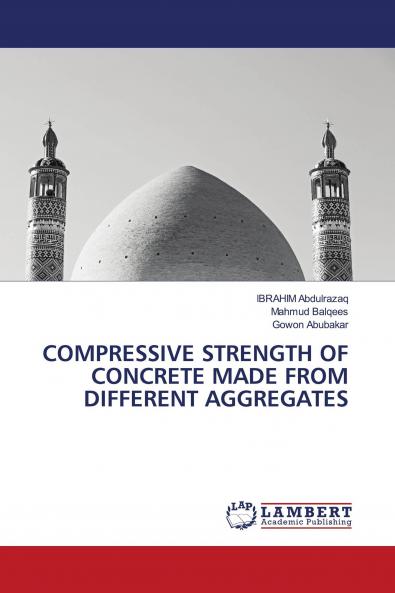
The study used a 1:2:4 mix design and a water-cement ratio of 0.5. Wooden square cubes of dimensions 100 x 100 x 100 mm were employed resulting in 42 concrete cubes.Tests were conducted to assess particle size distribution specific gravity bulk density aggregate impact value aggregate abrasion value and compressive strength at 7th and 28th days of curing. Notably after 7 days compressive strength results showed that concrete with a 10% iron fillings replacement (18.5 N/mm²) had a higher average strength than concrete with 100% river sand (17.6 N/mm²). However as the percentage of iron fillings increased to 20% (9.8 N/mm²) and 30% (7.1 N/mm²) the compressive strength decreased. On the other hand concrete with sawdust replacements at 10% (3.7 N/mm²) 20% (1.4 N/mm²) and 30% (0.5 N/mm²) exhibited significantly lower load-bearing capacity. These trends persisted at the 28th day with the compressive strength decreasing with increasing percentages of iron fillings (10%: 20.3 N/mm² 20%: 11.2 N/mm² 30%: 11.6 N/mm²) & sawdust (10%3.4 N/mm² 20%: 2.3 N/mm² 30%: 1.4 N/mm²). The findings suggest that a low percentage of iron fillings can be used in combination with river sand.

Piracy-free

Assured Quality

Secure Transactions

Fast Delivery

Sustainably Printed
Details
ISBN 13
9783659599071
Publication Date
-31-10-2024
Pages
-76
Weight
-116 grams
Dimensions
-150x220x4.5 mm
