

English


Paperback
₹8716
(All inclusive*)
Delivery Options
Please enter pincode to check delivery time.
*COD & Shipping Charges may apply on certain items.
Review final details at checkout.
Looking to place a bulk order? SUBMIT DETAILS
Delivery Options
Please enter pincode to check delivery time.
*COD & Shipping Charges may apply on certain items.
Review final details at checkout.
About The Book
Description
Author
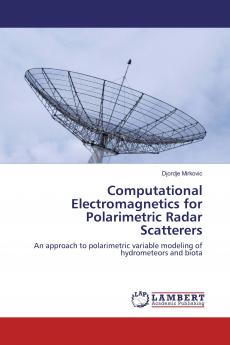
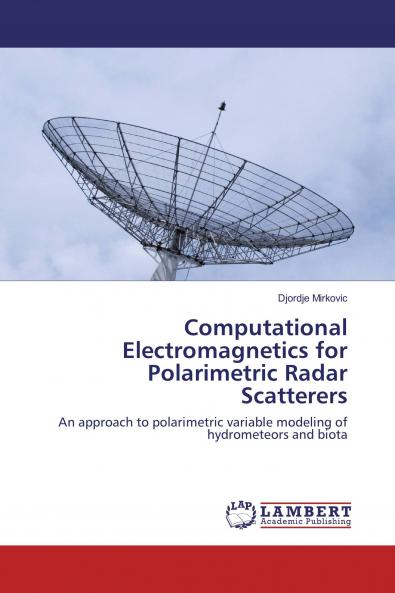
This book presents a systematic evaluation of current modeling procedures focusing on limitation sources and their effects to the overall process of polarimetric variable simulation. It re-evaluates limitations of the widely used T-Matrix approach and discusses sources of instability. To overcome limitations in scattering tools and approximations used in the polarimetric variable simulators a novel computational electromagnetic (CEM) based approach is proposed. For that purpose a CEM solver herein the robust commercially available WIPL-D is systematically explored. The goal of the study was to improve modeling of the polarimetric radar signatures and thus explain their meaning. The obtained results are out of reach of the non-CEM methods and prove the robustness and usefulness of the approach. Additionally the CEM based ensemble modeling could have a dramatic impact on the field of radar aeroecology in estimating numbers of organisms in the atmosphere and possibly genus based on radar observations. However to use the CEM physical models of the hydrometeors or biota must be designed and adapted within the CEM’s structure. Doing so is part of the novelty in this book.

Piracy-free

Assured Quality

Secure Transactions

Fast Delivery

Sustainably Printed
Details
ISBN 13
9783659866753
Publication Date
-09-04-2016
Pages
-272
Weight
-354 grams
Dimensions
-150x220x14.57 mm
