

English


₹5941
(All inclusive*)
Paperback
Delivery Options
Please enter pincode to check delivery time.
*COD & Shipping Charges may apply on certain items.
Review final details at checkout.
Looking to place a bulk order? SUBMIT DETAILS
Delivery Options
Please enter pincode to check delivery time.
*COD & Shipping Charges may apply on certain items.
Review final details at checkout.
About The Book
Description
Author
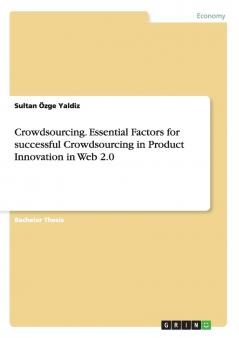
Bachelor Thesis from the year 2014 in the subject Business economics - Offline Marketing and Online Marketing grade: 13 Westfälische Hochschule Gelsenkirchen Bocholt Recklinghausen language: English abstract: At large innovation is a key factor for the success and persistence of organizations in today's business. In order to develop successful innovation information of two kinds is needed; information based on customers' and the market's needs as well as information on how to transform the gained knowledge into corresponding products (Diener and Piller 2011). The paradigm of Crowdsourcing can be applied to obtain both kinds of essential information enabled through direct interaction with customers and takers providing an enhanced inflow of intelligence. The work at hand deals with Crowdsourcing and particularly crowd-based product innovation. Crowdsourcing is a relatively new conceptualized paradigm which is why the literature does not offer countless research papers on the topic and the market is not overloaded with companies applying the concept although the theory is very promising. Nonetheless not all companies who have ventured the step towards Crowdsourcing have experienced positive outcomes: on the contrary some encountered rants from the crowd as well as image losses (Papsdorf and Voß 2009).The first purpose of this work is to illustrate how broad the term Crowdsourcing is and what opportunities it offers for businesses by providing an overview of the common forms. a further purpose is to depict where in what form and how those activities take place. The cornerstones for a successful outcome are already set at the beginning of a project whereby this paper describes single decisions to make along a Crowdsourcing process and their influence on the project's course in order to understand how and why each decision during the process can be determining. thus marking a third purpose. The focus of this third purpose is on Crowd Innovation l

Piracy-free

Assured Quality

Secure Transactions

Fast Delivery

Sustainably Printed
Details
ISBN 13
9783656766872
Publication Date
-15-10-2014
Pages
-78
Weight
-107 grams
Dimensions
-148x210x4.74 mm
