

English


Paperback
₹2449
₹2735
10.46% OFF
(All inclusive*)
Delivery Options
Please enter pincode to check delivery time.
*COD & Shipping Charges may apply on certain items.
Review final details at checkout.
Looking to place a bulk order? SUBMIT DETAILS
Delivery Options
Please enter pincode to check delivery time.
*COD & Shipping Charges may apply on certain items.
Review final details at checkout.
About The Book
Description
Author
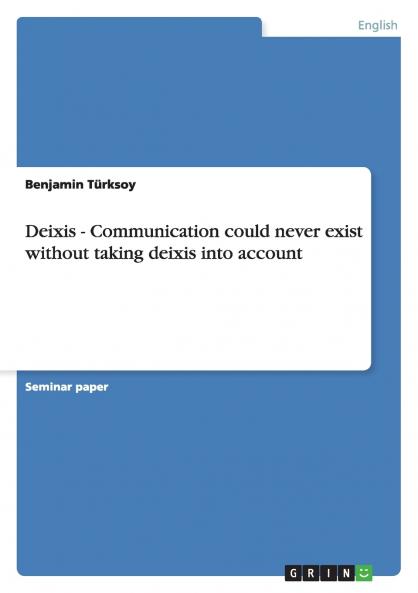
Seminar paper from the year 2007 in the subject English Language and Literature Studies - Linguistics University of Hamburg language: English abstract: In language various ideas can be expressed in alternating ways which in the end can all have the same meaning. However the speaker's choices are influenced and restricted by linguistic factors.The following example of a fictive story shows how various different words can all have the same meaning Yesterday I went to the park and I saw a boy who killed a pigeon by throwing big chunks of bread at its head. This made me so mad that I had to walk up to the boy and yell at him. Telling him that he shouldn't have done what he did he told me that he didn't do it intentionally. In this little story this what he did and it all refer to the action of the boy killing the duck with a piece of bread.When the speaker of the story chose the pronoun it he must have thought that his audience would easily identify it as the action of killing the duck. Speakers often tend to use pronouns instead of using the antecedent because it simplifies and shortens speech analysis. However sometimes speech analysis can become very complicated and pronouns confuse the listener let alone simplify the discourse. For example: (1) Peter hit Harry. After this he didn't like him anymore.In this case the listener would have to have contextual information to determine whether Peter did not like Harry anymore or vice versa. Just from reading the sentence the reader would not know what is really going on. As in this example or in many other utterances and texts where chains of pronouns strike the audience discourse analysis becomes highly complicated.

Piracy-free

Assured Quality

Secure Transactions

Fast Delivery

Sustainably Printed
Details
ISBN 13
9783656142201
Publication Date
-10-03-2012
Pages
-26
Weight
-46 grams
Dimensions
-148x210x2.04 mm
