

English


Paperback
₹3506
(All inclusive*)
Delivery Options
Please enter pincode to check delivery time.
*COD & Shipping Charges may apply on certain items.
Review final details at checkout.
Looking to place a bulk order? SUBMIT DETAILS

Piracy-free

Assured Quality

Secure Transactions
About The Book
Description
Author
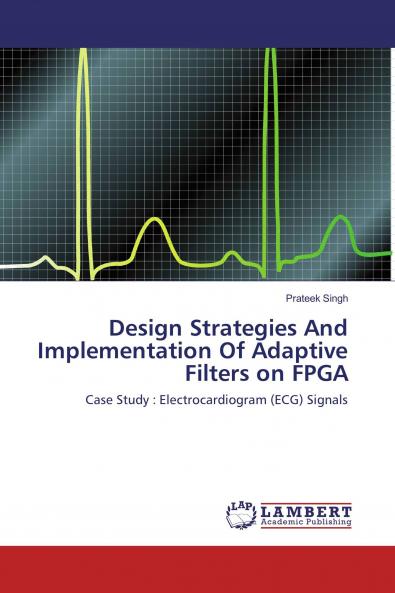
ECG is an electrical representation of blood pumping activity of the heart which can be recorded easily with surface electrodes on the limbs or chest. We can filter high frequency and low frequency noises by implementing fixed filters but motion artefacts and noises related to movement of muscles can not be filtered by fixed filters as we don’t have any prior information regarding the nature of these noises and electromyogram (EMG) signals are superimposed on ECG signals because of physical proximity of the body movement. A static filter is required to remove all the noise frequencies which could overly abase the attribute of the ECG since the heartbeat would also likely have frequency components in the rejected range. To outfox this latent loss of information an adaptive filter is used. Thus adaptive technique allows a filter with a greater acceptance ambit which means our filter provide output signal quality dead on target for medical diagnoses. The adaptive filter here is trained using LMS algorithm and RLS algorithm.The algorithms are enforced using Simulink as a reference model where the blocks are taken from the Xilinx block set.
Piracy-free
Assured Quality
Secure Transactions
Delivery Options
Please enter pincode to check delivery time.
*COD & Shipping Charges may apply on certain items.
Review final details at checkout.
Details
ISBN 13
9783659915680
Publication Date
-05-07-2016
Pages
-64
Weight
-96 grams
Dimensions
-150x220x3.89 mm
