

English


Paperback
₹4195
(All inclusive*)
Delivery Options
Please enter pincode to check delivery time.
*COD & Shipping Charges may apply on certain items.
Review final details at checkout.
Looking to place a bulk order? SUBMIT DETAILS
Delivery Options
Please enter pincode to check delivery time.
*COD & Shipping Charges may apply on certain items.
Review final details at checkout.
About The Book
Description
Author
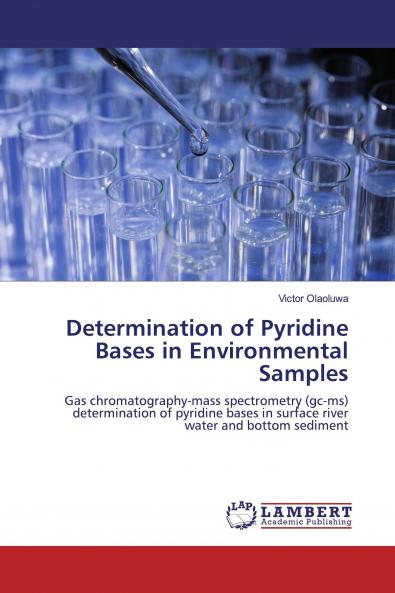
Pyridine a volatile material is determined by GC analysis using MS detection in environmental samples such as river water and bottom sediment. A measured sample is collected in a beaker and is preserved cryogenically (low temperature) with ice usually 40C to ensure that the pyridine bases do not become volatilized. The ensuing stage is the extraction or distillation process which is carried out by dissolving the sample in an organic solvent mixture of n-Hexane and Dichloromethane. This is to affirm absolute purification process. After distillation from samples the pyridine bases are concentrated on a rotary evaporator and determined by Capillary Gas Chromatography-Selected-Ion-Monitoring (GC-SIM). The determination of sixteen bases is done using a 15mm × 0.53mm Ion Detection Capillary Column followed by Selected-Ion-Monitoring. The detection limits were 10 - 15µg/L and percent recoveries from river water and bottom sediment were over 84% with coefficient of variation below 4% (n=7) except for pyridine. This method is capable of the simultaneous determination of sixteen pyridine bases with sufficient sensitivity and accuracy to be applicable to environmental samples.

Piracy-free

Assured Quality

Secure Transactions

Fast Delivery

Sustainably Printed
Details
ISBN 13
9786200587497
Publication Date
-18-02-2020
Pages
-52
Weight
-81 grams
Dimensions
-150x220x3.27 mm
