


English




Paperback
₹1658
(All inclusive*)
Delivery Options
Please enter pincode to check delivery time.
*COD & Shipping Charges may apply on certain items.
Review final details at checkout.
Looking to place a bulk order? SUBMIT DETAILS

Piracy-free

Assured Quality

Secure Transactions
About The Book
Description
Author
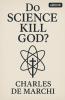
<p>We live in a time where science dazzles us. It explains phenomena once shrouded in mystery from the birth of galaxies to the complexity of our DNA. With such extraordinary power to uncover the mechanics of reality it's no surprise that some wonder: in a world where science thrives is there still room for God?</p><p> The title is intentionally provocative echoing the rhetoric of public intellectuals like Richard Dawkins who argue that science has rendered religious belief obsolete especially after the acceptance of Darwinian evolution.</p><p>But my aim is not to refute science - quite the opposite. The book embraces it. Science is one of the most remarkable achievements of the human mind. It helps us map black holes track viruses and understand the origin of life. What I question however is whether scientific knowledge alone can address the full scope of human existence.</p><p>At the core of my argument lies a simple idea: science and religion answer different kinds of questions. Science is concerned with the <em>how</em> - processes causes mechanisms. Faith on the other hand ventures into the realm of <em>why</em> - meaning purpose moral value. To conflate these two domains is to misunderstand both.</p><p>And yet today we often see a stark polarization. On one side a militant skepticism claims science as the only valid way of knowing. On the other a rigid dogmatism refuses to engage with the empirical world. My book rejects both extremes. Instead I advocate for dialogue - not to dilute either side but to enrich our view of reality.</p><p>Critics of religion often point to evolution as proof that we no longer need God. But must evolution be viewed as an enemy of faith? I suggest an alternative: what if evolution itself is a mechanism through which divine creativity unfolds? Rather than being at odds science and faith can illuminate different dimensions of the same mystery.</p><p>History supports this view. Modern science did not arise in a vacuum. Many of its founders - Newton Kepler Pascal - were deeply religious. Their discoveries were not rejections of faith but expressions of it. They believed the universe operated according to rational laws because it was created by a rational mind.</p><p>This is not to suggest that science proves God. Nor does it endorse any particular religious doctrine. Instead it invites us to acknowledge the <strong>limits of science</strong> not as a weakness but as a recognition of its domain. Science tells us what <em>is</em>. Faith explores what <em>ought</em> to be. One measures. The other meditates.</p><p>The real threat in my view is reductionism - whether scientific or religious. When science claims to explain everything even meaning and morality it overreaches. When religion dismisses all other forms of knowledge it isolates itself. Both become caricatures of their true potential.</p><p>What we need is humility - the intellectual kind that acknowledges the richness and limits of our tools. Science is extraordinary but it cannot answer every question. Faith when mature and open need not fear scientific progress. The two are not competitors in a zero-sum game. They are partners in a greater human pursuit: understanding and wisdom.</p><p><em>Did Science Killed God?</em> is not a manifesto. It is an invitation - to think to question and to converse across boundaries. In an age of growing polarization perhaps the most revolutionary act is to listen. Not to silence doubt but to walk alongside it. To honor the precision of science and the depth of faith.</p><p>After all between atoms and souls between equations and questions we are not merely seeking facts. We are searching for meaning.</p>
Piracy-free
Assured Quality
Secure Transactions
Delivery Options
Please enter pincode to check delivery time.
*COD & Shipping Charges may apply on certain items.
Review final details at checkout.
Details
ISBN 13
9798232612177
Publication Date
-08-10-2025
Pages
-212
Weight
-256 grams
Dimensions
-140x216x12.31 mm
