



Hardback
₹8326
₹13700
39.22% OFF
(All inclusive*)
Delivery Options
Please enter pincode to check delivery time.
*COD & Shipping Charges may apply on certain items.
Review final details at checkout.
Looking to place a bulk order? SUBMIT DETAILS

Piracy-free

Assured Quality

Secure Transactions
About The Book
Description
Author
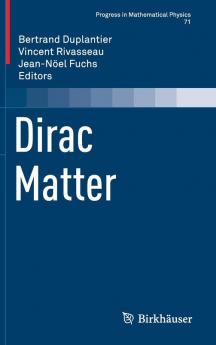
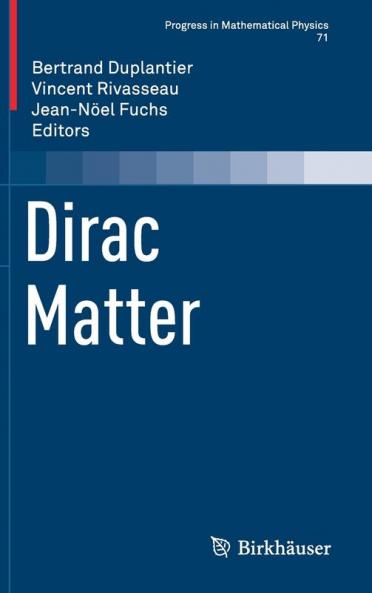
<p>This fifteenth volume of the Poincare Seminar Series Dirac Matter describes&nbsp;the surprising resurgence as a low-energy effective theory of conducting electrons&nbsp;in many condensed matter systems including graphene and topological insulators&nbsp;of the famous equation originally invented by P.A.M. Dirac for relativistic quantum</p><p>mechanics. In five highly pedagogical articles as befits their origin in lectures to a&nbsp;broad scientific audience this book explains why Dirac matters.&nbsp;Highlights include the detailed Graphene and Relativistic Quantum Physics&nbsp;written by the experimental pioneer Philip Kim and devoted to graphene a form</p><p>of carbon crystallized in a two-dimensional hexagonal lattice from its discovery in&nbsp;2004-2005 by the future Nobel prize winners Kostya Novoselov and Andre Geim to&nbsp;the so-called relativistic quantum Hall effect; the review entitled Dirac Fermions in&nbsp;Condensed Matter and Beyond written by two prominent theoreticians Mark Goerbig and Gilles Montambaux who consider many other materials than graphene&nbsp;collectively known as Dirac matter and offer a thorough description of the merging&nbsp;transition of Dirac cones that occurs in the energy spectrum in various experiments&nbsp;involving stretching of the microscopic hexagonal lattice; the third contribution entitled&nbsp;Quantum Transport in Graphene: Impurity Scattering as a Probe of the Dirac</p><p>Spectrum given by Hélène Bouchiat a leading experimentalist in mesoscopic&nbsp;physics with Sophie Guéron and Chuan Li shows how measuring electrical transport&nbsp;in particular magneto-transport in real graphene devices - contaminated by&nbsp;impurities and hence exhibiting a diffusive regime &nbsp;- allows one to deeply probe the&nbsp;Dirac nature of electrons. The last two contributions focus on topological insulators;&nbsp;in the authoritative Experimental Signatures of Topological Insulators Laurent&nbsp;Lévy reviews recent experimental progress in the physics of mercury-telluride samples&nbsp;under strain which demonstrates that the surface of a three-dimensional topological&nbsp;insulator hosts a two-dimensional massless Dirac metal; the illuminating final&nbsp;contribution by David Carpentier entitled Topology of Bands in Solids: From&nbsp;Insulators to Dirac Matter provides a geometric description of Bloch wave functions&nbsp;in terms of Berry phases and parallel transport and of their topological classification&nbsp;in terms of invariants such as Chern numbers and ends with a perspective on&nbsp;three-dimensional semi-metals as described by the Weyl equation.&nbsp;This book will be of broad general interest to physicists mathematicians and&nbsp;historians of science.</p>
Piracy-free
Assured Quality
Secure Transactions
Delivery Options
Please enter pincode to check delivery time.
*COD & Shipping Charges may apply on certain items.
Review final details at checkout.
Details
ISBN 13
9783319325354
Publication Date
-01-02-2017
Pages
-144
Weight
-319 grams
Dimensions
-156x234x9.53 mm
