


English



Paperback
₹6424
₹7578
15.23% OFF
(All inclusive*)
Delivery Options
Please enter pincode to check delivery time.
*COD & Shipping Charges may apply on certain items.
Review final details at checkout.
Looking to place a bulk order? SUBMIT DETAILS
Delivery Options
Please enter pincode to check delivery time.
*COD & Shipping Charges may apply on certain items.
Review final details at checkout.
About The Book
Description
Author(s)
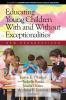
<p>Early childhood education (ECE) has always been intertwined with the use of developmentally appropriate practice (DAP). To support excellence in ECE it is critical to have the knowledge about individual children and child development principles combined with the knowledge of effective early learning practices. Effective early childhood education involves an interdisciplinary collaborative process that is influenced by many factors. We present these aforementioned realities in <em>Educating Young Children With and Without Exceptionalities: New Perspectives</em>. In addition we argue that general and special educators need to focus on applying new knowledge to better address critical issues that advance the field of educator preparation and improve educational outcomes for young children.</p><p>Early childhood research confirms the need for intensive intervention and remedial education&mdash;we need to avoid approaches that are &ldquo;too little&rdquo; or &ldquo;too late.&rdquo; Also proven to yield positive results for children are practices familiar to early childhood educators. These practices include relationship-based teaching and learning; partnering with families; adapting teaching for children from different backgrounds and for individual children; active meaningful and connected learning; and smaller class sizes. Evidence of the benefits of these practices suggests that they should be extended more widely into the elementary grades.</p><p>&nbsp;</p>

Piracy-free

Assured Quality

Secure Transactions
Details
ISBN 13
9781641135931
Publication Date
-28-02-2019
Pages
-180
Weight
-265 grams
Dimensions
-156x234x9.74 mm
