

English


₹3363
₹3540
5% OFF
(All inclusive*)
Paperback
Delivery Options
Please enter pincode to check delivery time.
*COD & Shipping Charges may apply on certain items.
Review final details at checkout.
Looking to place a bulk order? SUBMIT DETAILS
Delivery Options
Please enter pincode to check delivery time.
*COD & Shipping Charges may apply on certain items.
Review final details at checkout.
About The Book
Description
Author
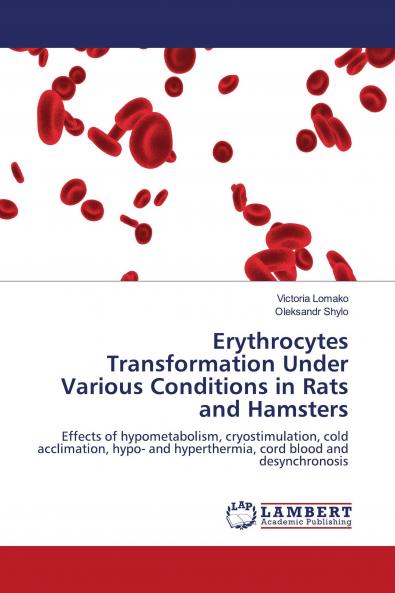
Dynamic of the erythrocytes transformation under various experimental conditions was studied. The changes determined by the species (outbred albino rats Rattus norvegicus or golden hamsters Mesocricetus auratus) and age of the animal the type and intensity of temperature exposure (general craniocerebral and immersion hypothermia whole body cryostimulation hypometabolism cold acclimation and hyperthermia) the level of changes in body temperature kind of others experimental conditions (injection of cryopreserved cord blood nucleated cells and circadian desynchronosis (shift of light-dark cycle) and was characterized by two scenarios. There was either a rapid elimination of defective and low-resistant forms of the erythrocytes from the blood and an increase in the proportion of normal and flattened (highly resistant) discocytes (strategy 1) or an increase in the number of reversibly (stomatocytes) and irreversibly (spherocytes) of altered forms of erythrocytes (strategy 2). During physiological aging the transformation of erythrocytes occurs along the stomacytic pathway.

Piracy-free

Assured Quality

Secure Transactions

Fast Delivery

Sustainably Printed
Details
ISBN 13
9786203027259
Publication Date
-27-11-2020
Pages
-80
Weight
-116 grams
Dimensions
-150x220x4.71 mm
