

English


Paperback
₹5745
₹7576
24.17% OFF
(All inclusive*)
Delivery Options
Please enter pincode to check delivery time.
*COD & Shipping Charges may apply on certain items.
Review final details at checkout.
Looking to place a bulk order? SUBMIT DETAILS
Delivery Options
Please enter pincode to check delivery time.
*COD & Shipping Charges may apply on certain items.
Review final details at checkout.
About The Book
Description
Author
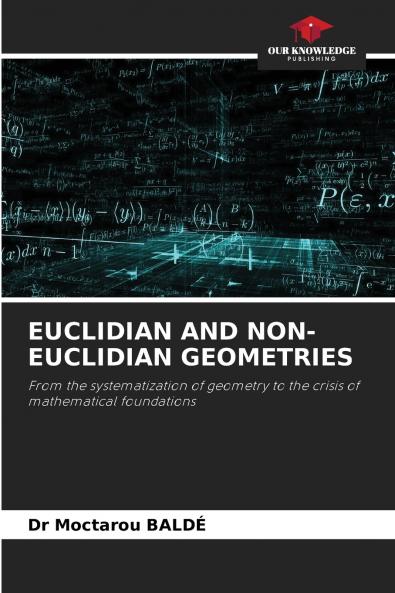
Despite its Egyptian origins and the discovery of fragments of geometric treatises in that part of the world it is Euclid who deserves credit for having constructed the first form of axiomatisation of mathematical principles. With him geometry ceased to be a collection of practical recipes or at best empirical statements and became a rational science. As the heir to the Hellenistic geometries of his time Euclid used them to his advantage to produce the first synthesis of geometry. For more than two millennia Euclidean geometry was considered the unsurpassable model in deductive theory. However in this essay after tracing the origins of the Euclidean system the author points out that the success of Euclidean geometry was called into question when vigilant mathematicians questioned the status of the fifth postulate known as the parallel postulate. The author's meticulous study which combines philosophical rigour with mathematical knowledge is therefore of considerable scientific interest and will certainly be very well received by the educated public.

Piracy-free

Assured Quality

Secure Transactions

Fast Delivery

Sustainably Printed
Details
ISBN 13
9786209010804
Publication Date
-22-08-2025
Pages
-52
Weight
-85 grams
Dimensions
-152x229x3.16 mm
