




This Book is Out of Stock!
English



Hardback
₹39412
(All inclusive*)
Delivery Options
*COD & Shipping Charges may apply on certain items.
Review final details at checkout.
Looking to place a bulk order? SUBMIT DETAILS

Piracy-free

Assured Quality

Secure Transactions
About The Book
Description
Author
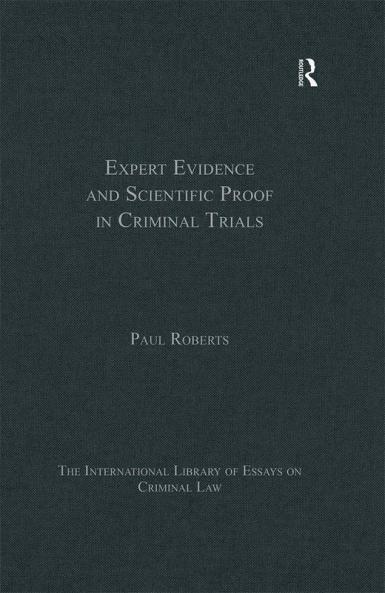
Forensic science evidence and expert witness testimony play an increasingly prominent role in modern criminal proceedings. Science produces powerful evidence of criminal offending, but has also courted controversy and sometimes contributed towards miscarriages of justice. The twenty-six articles and essays reproduced in this volume explore the theoretical foundations of modern scientific proof and critically consider the practical issues to which expert evidence gives rise in contemporary criminal trials. The essays are prefaced by a substantial new introduction which provides an overview and incisive commentary contextualising the key debates. The volume begins by placing ’forensic science’ in interdisciplinary focus, with contributions from historical, sociological, Science and Technology Studies (STS), philosophical and jurisprudential perspectives. This is followed by closer examination of the role of forensic science and other expert evidence in criminal proceedings, exposing enduring tensions and addressing recent controversies in the relationship between science and criminal law. A third set of contributions considers the practical challenges of interpreting and communicating forensic science evidence. This perennial battle continues to be fought at the intersection between the logic of scientific inference and the psychology of the fact-finder’s ’common sense’ reasoning. Finally, the volume’s fourth group of essays evaluates the (limited) success of existing procedural reforms aimed at improving the reception of expert testimony in criminal adjudication, and considers future prospects for institutional renewal - with a keen eye to comparative law models and experiences, success stories and cautionary tales. Contents: Introduction. Part I Interdisciplinary ‘Forensic Science’ - Theoretical Foundations: Historical and practical considerations regarding expert testimony, Learned Hand; A just measure of science, David Nelken; Science and technology studies on trial: dilemmas of expertise, Michael Lynch and Simon Cole; Of truth, in science and in law, Susan Haack; The irrelevance, and central relevance, of the boundary between science and non-science in the evaluation of expert witness reliability, D. Michael Risinger. Part II Expert Evidence in Criminal Proceedings: Fingerprint evidence in an age of DNA profiling, Jennifer L. Mnookin; Science in the criminal process, Paul Roberts; ‘Junk science’: the criminal cases, Paul C. Giannelli; Sounding out expert voice identification, David Ormerod; Atkins v The Emperor: the ‘cautious’ use of unreliable ‘expert’ opinion, Gary Edmond, Richard Kemp, Glenn Porter, David Hamer, Mike Burton, Katherine Biber and Mehera San Roque; Forensic science evidence in question, Mike Redmayne, Paul Roberts, Colin Aitken and Graham Jackson. Part III Interpreting Forensic Science Evidence: A framework for analysis, Erica Beecher-Monas; The vision in ‘blind’ justice: expert perception, judgment, and visual cognition in forensic pattern recognition, Itiel E. Dror and Simon A. Cole; Forensic identification: from a faith-based ‘science’ to a scientific science, Michael J. Saks; Interpretation of statistical evidence in criminal trials: the prosecutor’s fallacy and the defense attorney’s fallacy, William C. Thompson and Edward L. Schumann; Presenting probabilities in court: the DNA experience, Mike Redmayne; Communicating opinion evidence in the forensic identification sciences: accuracy and impact, Dawn McQuiston-Surrett and Michael J. Saks; She blinded me with science: wrongful convictions and the ‘reverse CSI-effect’, Mark A. Godsey and Marie Alou. Part IV Procedural Reform in Comparative Perspective: The psychiatric expert in court, Anthony Kenny; Expertise and the Daubert decision, Ronald J. Allen; Eyes wide shut: hidden problems and future consequences of the fact-based validity standard, Joëlle Anne Moreno; Daubert, Schmaubert: criminal defendants and the short end of the science stick, Susan D. Rozelle; The Law Commission’s report on expert evidence in criminal proceedings, Gary Edmond and Andrew Roberts; Expert evidence and the Law Commission: implementation without legislation?, Tony Ward; Court experts and expert witnesses: have we a lesson to learn from the French?, J.R. Spencer; Forensic science in inquisitorial systems of criminal justice, Bron McKillop. Name index.
Piracy-free
Assured Quality
Secure Transactions
*COD & Shipping Charges may apply on certain items.
Review final details at checkout.
₹39412
Out Of Stock
All inclusive*
Details
ISBN 13
9781409466062
Publication Date
-11-10-2023
Pages
-664
Weight
-1152 grams
Dimensions
-169x244x36.11 mm
