


English



Paperback
₹3436
₹3599
4.53% OFF
(All inclusive*)
Delivery Options
Please enter pincode to check delivery time.
*COD & Shipping Charges may apply on certain items.
Review final details at checkout.
Looking to place a bulk order? SUBMIT DETAILS

Piracy-free

Assured Quality

Secure Transactions
About The Book
Description
Author
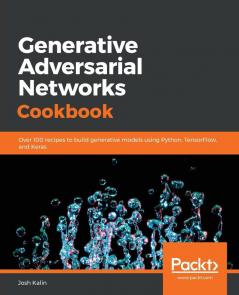
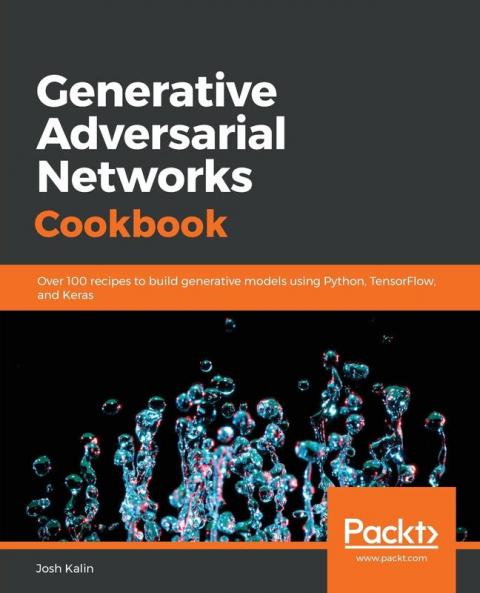
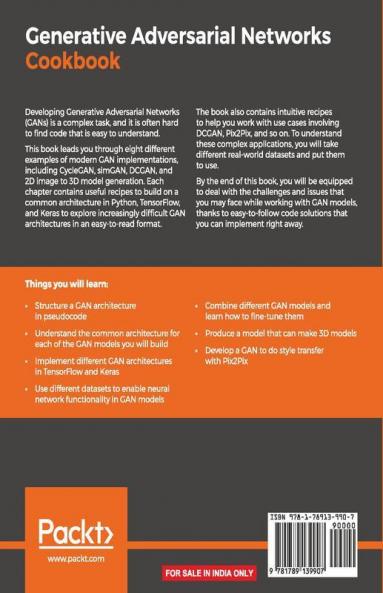
Simplify next-generation deep learning by implementing powerful generative models using Python TensorFlow and KerasKey FeaturesUnderstand the common architecture of different types of GANsTrain optimize and deploy GAN applications using TensorFlow and KerasBuild generative models with real-world data sets including 2D and 3D dataBook DescriptionDeveloping Generative Adversarial Networks (GANs) is a complex task and it is often hard to find code that is easy to understand.This book leads you through eight different examples of modern GAN implementations including CycleGAN simGAN DCGAN and 2D image to 3D model generation. Each chapter contains useful recipes to build on a common architecture in Python TensorFlow and Keras to explore increasingly difficult GAN architectures in an easy-to-read format. The book starts by covering the different types of GAN architecture to help you understand how the model works. This book also contains intuitive recipes to help you work with use cases involving DCGAN Pix2Pix and so on. To understand these complex applications you will take different real-world data sets and put them to use.By the end of this book you will be equipped to deal with the challenges and issues that you may face while working with GAN models thanks to easy-to-follow code solutions that you can implement right away.What you will learnStructure a GAN architecture in pseudocodeUnderstand the common architecture for each of the GAN models you will buildImplement different GAN architectures in TensorFlow and KerasUse different datasets to enable neural network functionality in GAN modelsCombine different GAN models and learn how to fine-tune themProduce a model that can take 2D images and produce 3D modelsDevelop a GAN to do style transfer with Pix2PixWho this book is forThis book is for data scientists machine learning developers and deep learning practitioners looking for a quick reference to tackle challenges and tasks in the GAN domain. Familiarity with machine learning concepts and working knowledge of Python programming language will help you get the most out of the book. About the Author Josh Kalin is a Physicist and Technologist focused on the intersection of robotics and machine learning. Josh works on advanced sensors industrial robotics machine learning and automated vehicle research projects. Josh holds degrees in Physics Mechanical Engineering and Computer Science. In his free time he enjoys working on cars (has owned 36 vehicles and counting) building computers and learning new techniques in robotics and machine learning (like writing this book).
Piracy-free
Assured Quality
Secure Transactions
Delivery Options
Please enter pincode to check delivery time.
*COD & Shipping Charges may apply on certain items.
Review final details at checkout.
Details
ISBN 13
9781789139907
Publication Date
-31-12-2018
Pages
-268
Weight
-474 grams
Dimensions
-191x235x14.37 mm
