

English


Hardback
₹15882
₹18436
13.85% OFF
(All inclusive*)
Delivery Options
Please enter pincode to check delivery time.
*COD & Shipping Charges may apply on certain items.
Review final details at checkout.
Looking to place a bulk order? SUBMIT DETAILS
Delivery Options
Please enter pincode to check delivery time.
*COD & Shipping Charges may apply on certain items.
Review final details at checkout.
About The Book
Description
Author
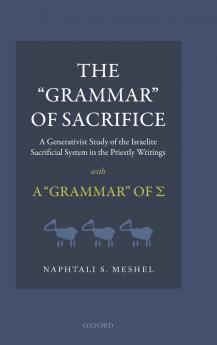
The notion that rituals like natural languages are governed by implicit rigorous rules led scholars in the last century harking back to the early Indian grammarian Patanjali to speak of a grammar or syntax of ritual particularly sacrificial ritual. Despite insightful examples of<br>ritual complexes that follow hierarchical rules akin to syntactic structures in natural languages and ambitious attempts to imagine a Universal Grammar of sacrificial ritual no single comprehensive grammar of any ritual system has yet been composed. <p/>This book offers the first such grammar. Centering on Σ-the idealized sacrificial system represented in the Priestly laws in the Pentateuch--it demonstrates that a ritual system is describable in terms of a set of concise unconsciously internalized generative rules analogous to the grammar of a<br>natural language. Despite far-reaching diachronic developments reflected in Second Temple and rabbinic literature the ancient Israelite sacrificial system retained a highly unchangeable grammar which is abstracted and analysed in a formulaic manner. <p/>The limits of the analogy to linguistics are stressed: rather than categories borrowed from linguistics such as syntax and morphology the operative categories of Σ are abstracted inductively from the ritual texts: <em>zoemics</em>--the study of the classes of animals used in ritual sacrifice; <em>jugation</em>-the<br>rules governing the joining of animal and non-animal materials; <em>hierarchics</em>-the tiered structuring of sacrificial sequences; and <em>praxemics</em>--the analysis of the physical activity comprising sacrificial procedures. Finally the problem of <em>meaning</em> in non-linguistic ritual systems is addressed.<br>

Piracy-free

Assured Quality

Secure Transactions

Fast Delivery

Sustainably Printed
Details
ISBN 13
9780198705567
Publication Date
-01-09-2014
Pages
-298
Weight
-519 grams
Dimensions
-156x234x17.46 mm
