


English


Paperback
₹1810
₹1955
7.42% OFF
(All inclusive*)
Delivery Options
Please enter pincode to check delivery time.
*COD & Shipping Charges may apply on certain items.
Review final details at checkout.
Looking to place a bulk order? SUBMIT DETAILS
Delivery Options
Please enter pincode to check delivery time.
*COD & Shipping Charges may apply on certain items.
Review final details at checkout.
About The Book
Description
Author(s)
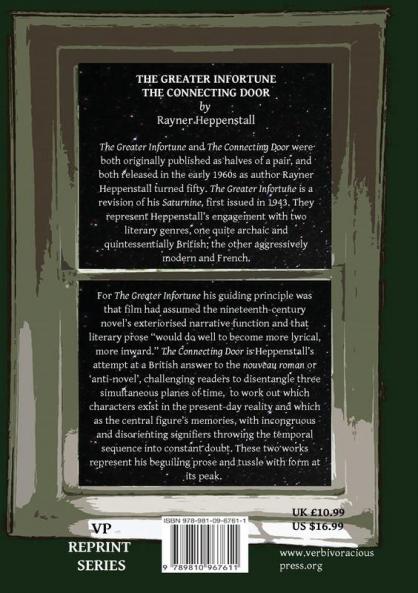
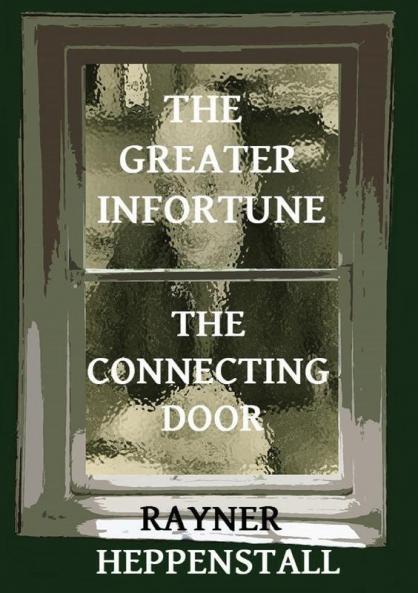
<p><em>The Greater Infortune</em> and<em> The Connecting Door </em>were both originally published as halves of a pair and both released in the early 1960s as author Rayner Heppenstall turned fifty. The Greater Infortune is a revision of his <em>Saturnine</em> first issued in 1943. They represent Heppenstall&rsquo;s engagement with two literary genres one quite archaic and quintessentially British; the other aggressively modern and French. For <em>The Greater Infortune</em> his guiding principle was that film had assumed the nineteenth-century novel&rsquo;s exteriorised narrative function and that literary prose &ldquo;would do well to become more lyrical more inward.&rdquo; <em>The Connecting Door</em> is Heppenstall&rsquo;s attempt at a British answer to the nouveau roman or &lsquo;anti-novel&rsquo; challenging readers to disentangle three simultaneous planes of time&nbsp; to work out which characters exist in the present-day reality and which as the central figure&rsquo;s memories with incongruous and disorienting signifiers throwing the temporal sequence into constant doubt. These two works represent his beguiling prose and tussle with form at its peak.</p><p>&ldquo;You have only to read a novel that interweaves past and present clumsily to appreciate Mr. Heppenstall&rsquo;s deftness. He has an eye so sharp it dazzles and sometimes hurts.&rdquo; &mdash; Isabel Quigley <em>The Guardian</em></p><p>&ldquo;Mr Heppenstall&rsquo;s rapid nervous storytelling makes most other novelists look like crawling removal vans.&rdquo; &mdash; V.S. Pritchett</p>

Piracy-free

Assured Quality

Secure Transactions

Fast Delivery

Sustainably Printed
Details
ISBN 13
9789810967611
Publication Date
-02-09-2015
Pages
-300
Weight
-366 grams
Dimensions
-148x210x16.69 mm
