



This Book is Out of Stock!
English



Hardback
₹30479
(All inclusive*)
Delivery Options
*COD & Shipping Charges may apply on certain items.
Review final details at checkout.
Looking to place a bulk order? SUBMIT DETAILS
*COD & Shipping Charges may apply on certain items.
Review final details at checkout.
₹30479
Out Of Stock
All inclusive*
About The Book
Description
Author
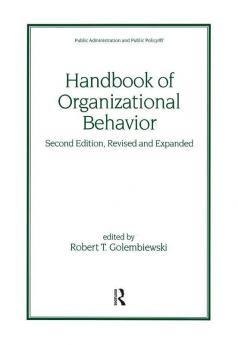
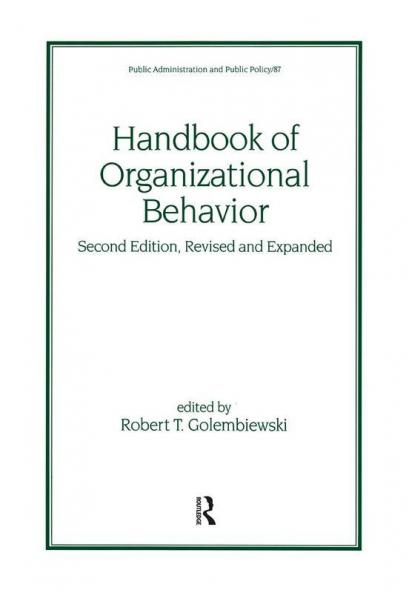
<p>Building upon the strengths of the first edition while continuing to extend the influence and reach of organizational behavior (OB), the Second Edition of this groundbreaking reference/ text analyzes OB from a business marketing perspective-offering a thorough treatment of central, soon-to-be central, contiguous, and emerging topics of OB to facilitate greater viability and demand of OB practice. <br>New edition incorporates more comparative perspectives throughout!<br>Contributing to the dynamic, interdisciplinary state of OB theory and practice, the Handbook of Organizational Behavior, Second Edition</p><li>comprehensively covers strategic and critical issues of the OB field with descriptive analyses and full documentation <br> </li><li>details the essential principles defining core OB such as organizational design, structure, culture, leadership theory, and risk taking <br> </li><li>advances solutions to setting operational definitions throughout the field <br> </li><li>comparatively discusses numerous situations and variables to provide clarity to mixed or inconclusive research findings <br> </li><li>utilizes cross-cultural approaches to examine recent issues concerning race, ethnicity, and gender <br> </li><li>reevaluates value standards and paradigms of change in OB <br> </li><li>investigates cross-national examples of OB development, including case studies from the United States and India <br> </li><li>and much more!<br>Written by 45 worldwide specialists and containing over 3500 references, tables, drawings, and equations, the Handbook of Organizational Behavior, Second Edition is a definitive reference for public administrators, consultants, organizational behavior specialists, behavioral psychologists, political scientists, and sociologists, as well as a necessary and worthwhile text for upper-level undergraduate and graduate students taking organizational behavior courses in the departments of public administration, psychology, management, education, and sociology.</li> <p>Introduction: Fitting a Market Metaphor to Organizational Behavior<br>Robert T. Golembiewski<br><br>Some Standard or Wheelhorse Themes<br><br>The Contingency Approach to Organizational Design<br>Paul R. Lawrence<br>Work Motivation<br>Hal G. Rainey<br>Motivation by Goal Setting<br>Edwin A. Locke<br>Conservation of Resources Theory: Applications to Stress and Management in the Workplace <br>Stevan E. Hobfoll and Arie Shirom<br>Small Group Research: Autonomous Teams and Progress on Issues of Context and Levels of Analysis<br>Claus W. Langfred and Mark T. Shanley<br>Organizational Culture: It's Alive! It's Alive! But There's No Fixed Address!<br>Robert G. Isaac and Douglas C. Pitt<br>Organization Design<br>William B. Stevenson<br>Surveying Organizational Structures and Human Resource Practices: The National Organizations Study<br>Peter V. Marsden, Arne L. Kalleberg, and David Knoke<br>Risk Taking in Organizations<br>Myron L. Weber<br>Leadership Theory in Postmodernist Organizations<br>Karl W. Kuhnert<br><br>Some Themes Requiring Enhanced Emphasis<br><br>Research on Race and Ethnicity: An Update and Analysis<br>Taylor Cox, Jr., Stella M. Nkomo, and Julia Welch<br>Human Factors in Information Systems<br>G. David Garson<br>Psychological Burnout in Organizations: Research and Intervention<br>Ronald J. Burke and Astrid M. Richardsen<br>Managing Organizational Conflict: Challenges for Organization Development and Change <br>M. Afzalur Rahim<br>Entrepreneurial Phenomena in a Cross-National Context<br>Urs E. Gattiker and John Parm Ulhøi<br>Work-Family Role Conflict and Employer Responsibility: An Organizational Analysis of Workplace Responses to a Social Problem<br>Paul M. Roman and Terry C. Blum<br>Management Training and Development<br>Dorothy Olshfski and Deborah Ann Cutchin<br>Valuing Diversity in a Global Economy: The Sad State of Organizations and Gender<br>Allan R. Cahoon and Julie I. A. Rowney<br><br>Some Themes with Great Potential<br><br>Wisdom's Critical Requirement for Scientific Objectivity in Organizational Behavior Research: Explicit Reporting of Researcher Values<br>Gordon A. Walter<br>Postmodernism: Implications for Organization Theory?<br>Dale Skip Newberg<br>Behavioral Research in Auditing: A Review and Synthesis<br>Ronald A. Davidson<br>Hegemonic Masculinity and Organizational Behavior<br>Martin Kilduff<br>A Positive Revolution in Change: Appreciative Inquiry<br>David L. Cooperrider and Diana Whitney<br>Paradigms in Organizational Change: Change Agent and Change Target Perspectives<br>Achilles A. Armenakis, Stanley G. Harris, and Hubert S. Feild<br>Compensation: Trends and Expanding Horizons<br>Elizabeth M. Doherty and Walter R. Nord<br>A Way Out of No Way? Strategy, Structure, and the New Governance<br>Robert F. Durant<br>A New Perspective on Organizing in Industry<br>John Parm Ulhøi,Urs E. Gattiker, and Inger Bojsen<br>Transcending Cultural Boundaries for Human and Organization Development: Experiences of International Exchange Between India and the United States<br>Uma Jain</p>

Piracy-free

Assured Quality

Secure Transactions

Fast Delivery

Sustainably Printed
Details
ISBN 13
9780824703936
Publication Date
-24-10-2000
Pages
-828
Weight
-1542 grams
Dimensions
-178x254x44.54 mm
