

English


Paperback
₹3425
₹3599
4.83% OFF
(All inclusive*)
Delivery Options
Please enter pincode to check delivery time.
*COD & Shipping Charges may apply on certain items.
Review final details at checkout.
Looking to place a bulk order? SUBMIT DETAILS

Piracy-free

Assured Quality

Secure Transactions
About The Book
Description
Author
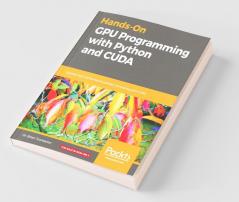
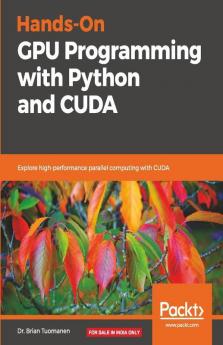
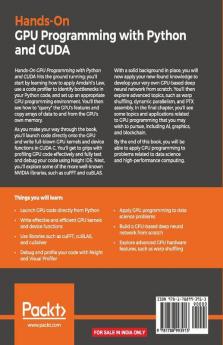
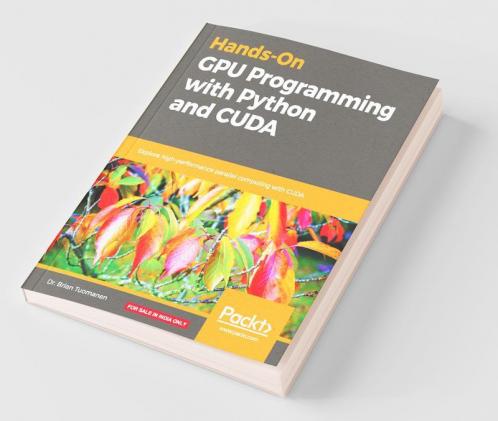
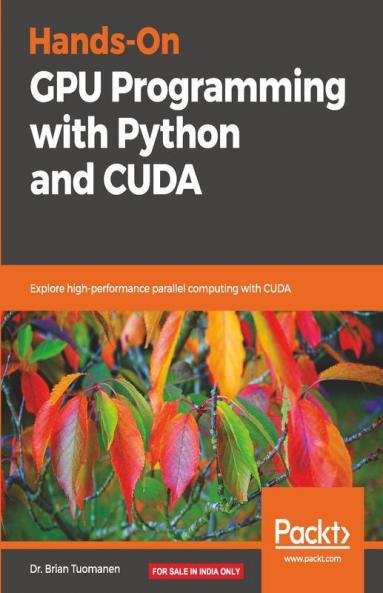
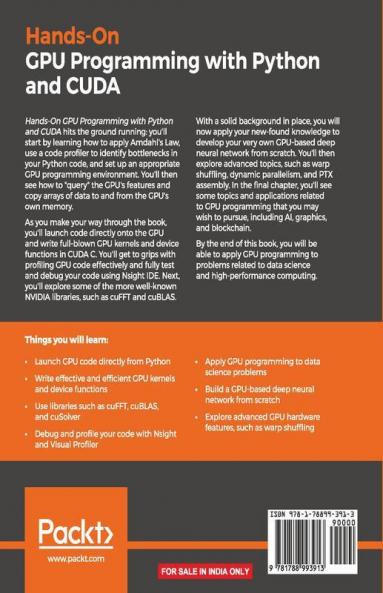
Build real-world applications with Python 2.7 CUDA 9 and CUDA 10. We suggest the use of Python 2.7 over Python 3.x since Python 2.7 has stable support across all the libraries we use in this book.Key FeaturesExpand your background in GPU programming―PyCUDA scikit-cuda and NsightEffectively use CUDA libraries such as cuBLAS cuFFT and cuSolverApply GPU programming to modern data science applicationsBook DescriptionHands-On GPU Programming with Python and CUDA hits the ground running: you’ll start by learning how to apply Amdahl’s Law use a code profiler to identify bottlenecks in your Python code and set up an appropriate GPU programming environment. You’ll then see how to “query” the GPU’s features and copy arrays of data to and from the GPU’s own memory.As you make your way through the book you’ll launch code directly onto the GPU and write full blown GPU kernels and device functions in CUDA C. You’ll get to grips with profiling GPU code effectively and fully test and debug your code using Nsight IDE. Next you’ll explore some of the more well-known NVIDIA libraries such as cuFFT and cuBLAS.With a solid background in place you will now apply your new-found knowledge to develop your very own GPU-based deep neural network from scratch. You’ll then explore advanced topics such as warp shuffling dynamic parallelism and PTX assembly. In the final chapter you’ll see some topics and applications related to GPU programming that you may wish to pursue including AI graphics and blockchain.By the end of this book you will be able to apply GPU programming to problems related to data science and high-performance computing.What you will learnLaunch GPU code directly from PythonWrite effective and efficient GPU kernels and device functionsUse libraries such as cuFFT cuBLAS and cuSolverDebug and profile your code with Nsight and Visual ProfilerApply GPU programming to datascience problemsBuild a GPU-based deep neuralnetwork from scratchExplore advanced GPU hardware features such as warp shufflingWho this book is forHands-On GPU Programming with Python and CUDA is for developers and data scientists who want to learn the basics of effective GPU programming to improve performance using Python code. You should have an understanding of first-year college or university-level engineering mathematics and physics and have some experience with Python as well as in any C-based programming language such as C C++ Go or Java. About the Author Dr. Brian Tuomanen has been working with CUDA and General-Purpose GPU Programming since 2014. He received his Bachelor of Science in Electrical Engineering from the University of Washington in Seattle and briefly worked as a Software Engineer before switching to Mathematics for Graduate School. He completed his Ph.D. in Mathematics at the University of Missouri in Columbia where he first encountered GPU programming as a means for studying scientific problems. Dr. Tuomanen has spoken at the US Army Research Lab about General Purpose GPU programming and has recently lead GPU integration and development at a Maryland based start-up company. He currently lives and works in the Seattle area.
Piracy-free
Assured Quality
Secure Transactions
Delivery Options
Please enter pincode to check delivery time.
*COD & Shipping Charges may apply on certain items.
Review final details at checkout.
Details
ISBN 13
9781788993913
Publication Date
-28-11-2018
Pages
-310
Weight
-545 grams
Dimensions
-191x235x16.53 mm
