

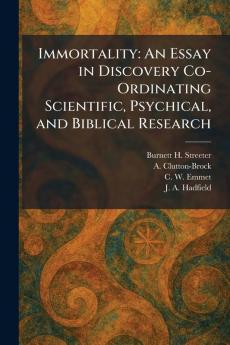
An Essay in Discovery Co-Ordinating Scientific, Psychical, and Biblical Research
Eng


₹2848
₹2894
1.59% OFF
(All inclusive*)
Paperback
Delivery Options
Please enter pincode to check delivery time.
*COD & Shipping Charges may apply on certain items.
Review final details at checkout.
Looking to place a bulk order? SUBMIT DETAILS
Delivery Options
Please enter pincode to check delivery time.
*COD & Shipping Charges may apply on certain items.
Review final details at checkout.
About The Book
Description
Author(s)
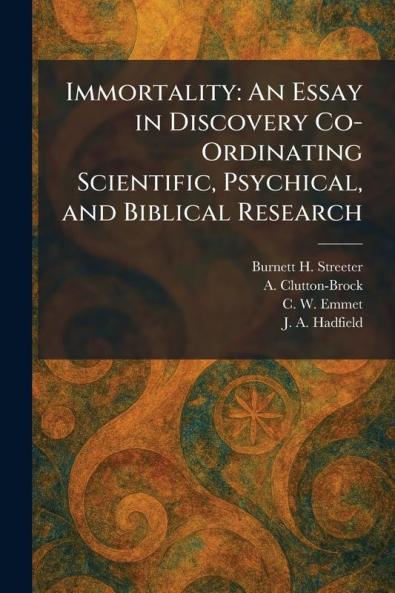
<p>Immortality: An Essay in Discovery Co-Ordinating Scientific Psychical and Biblical Research is an ambitious and multidisciplinary exploration into the persistence of the human soul and the nature of the afterlife. Co-authored by a distinguished group of thinkers including <b>Burnett H. Streeter</b> <b>A. Clutton-Brock</b> <b>C. W. Emmet</b> and <b>J. A. Hadfield</b> this work represents a collaborative effort to harmonize modern intellectual inquiry with spiritual conviction.</p><p>The text navigates the complex intersections of <i>scientific methodology</i> <i>psychical research</i> and <i>biblical interpretation</i> to address the fundamental question of human survival after death. By evaluating psychological insights into the mind-body relationship alongside theological reflections on the resurrection the authors provide a rigorous intellectual framework for understanding the destiny of the individual. The essays delve into the validity of spiritualistic phenomena while maintaining a focus on the moral and spiritual implications of an eternal existence.</p><p>Significant for its historical context and philosophical depth Immortality offers a compelling synthesis of ideas that remains relevant to students of religious philosophy and eschatology. It stands as a profound inquiry into how faith and reason can coexist in the search for truth regarding the human condition beyond biological life.</p><p>This work has been selected by scholars as being culturally important and is part of the knowledge base of civilization as we know it. This work was reproduced from the original artifact and remains as true to the original work as possible. Therefore you may see the original copyright references library stamps (as most of these works have been housed in our most important libraries around the world) and other notations in the work.</p><p>This work is in the public domain in the United States of America and possibly other nations. Within the United States you may freely copy and distribute this work as no entity (individual or corporate) has a copyright on the body of the work.</p><p>As a reproduction of a historical artifact this work may contain missing or blurred pages poor pictures errant marks etc. Scholars believe and we concur that this work is important enough to be preserved reproduced and made generally available to the public. We appreciate your support of the preservation process and thank you for being an important part of keeping this knowledge alive and relevant.</p>

Piracy-free

Assured Quality

Secure Transactions

Fast Delivery

Sustainably Printed
Details
ISBN 13
9781025362335
Publication Date
-14-02-2026
Pages
-408
Weight
-577 grams
Dimensions
-156x234x21.22 mm
