

English


Paperback
₹1691
₹1859
9.04% OFF
(All inclusive*)
Delivery Options
Please enter pincode to check delivery time.
*COD & Shipping Charges may apply on certain items.
Review final details at checkout.
Looking to place a bulk order? SUBMIT DETAILS
Delivery Options
Please enter pincode to check delivery time.
*COD & Shipping Charges may apply on certain items.
Review final details at checkout.
About The Book
Description
Author
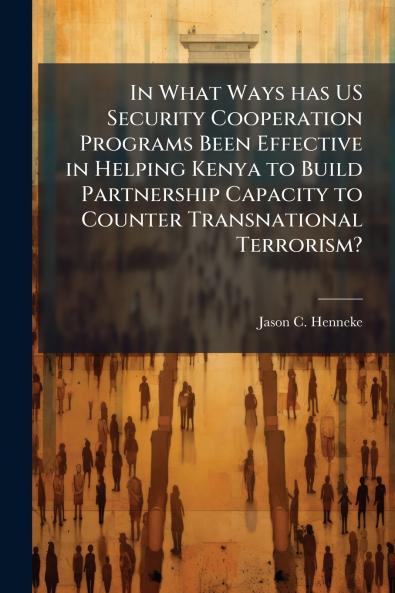
<p>This monograph uses Kenya as a case study to analyze the US Security Cooperation role and process in building host-nation capacity to meet the needs of Kenya to counter transnational terrorists' networks. US counterterrorism operations since 9/11 have explicitly demonstrated the US requirement to take an indirect approach to ensuring national security as part of an international community combating transnational terrorists' networks. In addition to capacity building regional focus from all agencies with the US Government (USG) is required for a coordinated and effective approach in the GWOT. The United States began formal relations with Kenya in 1981 with air and port basing agreements. Kenya's strategic location facilitated access for stability and humanitarian operations in the western Indian Ocean and east Africa. The events of 9/11 highlighted the US requirement for security partners in combating transnational terrorists and Kenya became a central front on the Global War on Terror (GWOT) due to its strategic location and willingness to ally. The partnership that started during the Cold War has carried on through to today's war on transnational terrorists. Kenya is one of the three anchor states in sub-Saharan Africa along with Nigeria and South Africa essential in stabilizing Africa. The program with Kenya focused on three general lines of effort to include foreign assistance defense security cooperation and assistance programs and counter-terrorism training programs. In general all three have been effective for Kenya. In specifics the lack of a coordinated regional USG effort reduced the effectiveness of on-going programs to counter the transnational threat in the region. The nature of capacity building and countering terrorism requires a long-term strategy. The requirement to get initial successes in short and mid-term are met through the Defense and Counter-Terrorism efforts. The success in these areas is due to tailoring these programs to the requi</p><p>This work has been selected by scholars as being culturally important and is part of the knowledge base of civilization as we know it. This work was reproduced from the original artifact and remains as true to the original work as possible. Therefore you will see the original copyright references library stamps (as most of these works have been housed in our most important libraries around the world) and other notations in the work.</p><p>This work is in the public domain in the United States of America and possibly other nations. Within the United States you may freely copy and distribute this work as no entity (individual or corporate) has a copyright on the body of the work.</p><p>As a reproduction of a historical artifact this work may contain missing or blurred pages poor pictures errant marks etc. Scholars believe and we concur that this work is important enough to be preserved reproduced and made generally available to the public. We appreciate your support of the preservation process and thank you for being an important part of keeping this knowledge alive and relevant.</p>

Piracy-free

Assured Quality

Secure Transactions

Fast Delivery

Sustainably Printed
Details
ISBN 13
9781288257430
Publication Date
-09-11-2012
Pages
-74
Weight
-119 grams
Dimensions
-156x234x4 mm
