

English



₹1228
(All inclusive*)
Paperback
Delivery Options
Please enter pincode to check delivery time.
*COD & Shipping Charges may apply on certain items.
Review final details at checkout.
Looking to place a bulk order? SUBMIT DETAILS
Delivery Options
Please enter pincode to check delivery time.
*COD & Shipping Charges may apply on certain items.
Review final details at checkout.
About The Book
Description
Author
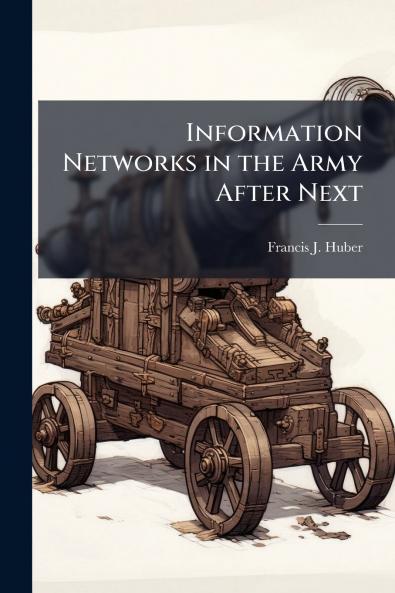
<p>The Army After Next envisions an Army which has two key attributes Knowledge and Speed. Speed is the ability of weapons systems to move faster on the battlefield. Knowledge is the ability of forces throughout the battlefield to see themselves and the enemy through the advantages of Sensors computers and the networks that connect them. In order for this vision to become a reality the sensors computers and weapon control systems of the Army After Next must have a robust reliable and secure data network to interlink them or the envisioned advantages of this force will be abrogated. This monograph examines the direction of the U.S Army at the end of the twentieth century through its Force XXI initiates the Joint community in the Joint Tactical Radio System program the U.S. Marine Corps in their Operational Maneuver from the Sea and the U.S. Navy with the High Speed MObile interNET (MONET). It also examines two commercial alternatives Ricochet Micro Cellular and Cellular Packet Data (CPD) for their applicability and leverage for designing the Intelligent Information Grid for the Army After Next. The focus of the examination is on the applicability of the systems for echelons at Brigade and Below (EBB). Providing data communications networks at this echelon presents the greatest challenge to the Army After Next because of the lethal and mobile nature of the brigade combat environment in the twenty first century. The study concludes that the current U.S. Army architecture Force XXI is inadequate to meet the challenges of the Army After Next. However the Joint Tactical Radio System (JTRS) as it is currently envisioned with some incorporation of the technologies presented by the Ricochet commercial network does present a superior alternative for the Intelligent Information Grid (I2G).</p><p>This work has been selected by scholars as being culturally important and is part of the knowledge base of civilization as we know it. This work was reproduced from the original artifact and remains as true to the original work as possible. Therefore you will see the original copyright references library stamps (as most of these works have been housed in our most important libraries around the world) and other notations in the work.</p><p>This work is in the public domain in the United States of America and possibly other nations. Within the United States you may freely copy and distribute this work as no entity (individual or corporate) has a copyright on the body of the work.</p><p>As a reproduction of a historical artifact this work may contain missing or blurred pages poor pictures errant marks etc. Scholars believe and we concur that this work is important enough to be preserved reproduced and made generally available to the public. We appreciate your support of the preservation process and thank you for being an important part of keeping this knowledge alive and relevant.</p>

Piracy-free

Assured Quality

Secure Transactions

Fast Delivery

Sustainably Printed
Details
ISBN 13
9781288257799
Publication Date
-09-11-2012
Pages
-48
Weight
-84 grams
Dimensions
-156x234x2.52 mm
