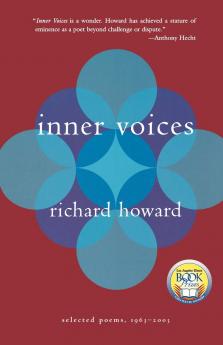
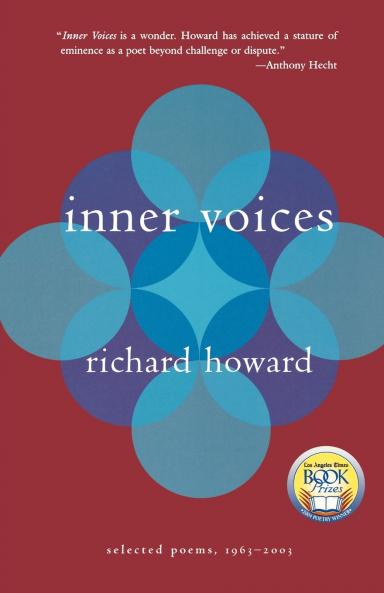
The poems of Pulitzer Prize-winner Richard Howard are noted for their unique dramatic force and for preserving in their graceful exquisitely wrought lines human utterance at its most urbane. Here in the first volume to draw together material from Howard''s twelve books of poems readers can fully appreciate the erudite nuances of his lyric poetry and the superb human and historical bravura of his dramatic monologues and imagined conversations among famous figures. Inner Voices leaves no doubt as to why Howard has been a powerful presence in American poetry for 40 years (The New York Times Book Review). Richard Howard is a poet scholar teacher critic and translator. The author of more than a dozen books including Paper Trail: Selected Prose 1965-2003 he is the recipient of both the Pulitzer Prize for Poetry and the National Book Award for translation. He teaches at Columbia University and is poetry editor of The Paris Review. Winner of the Los Angeles Times Book Prize for Poetry The poems of Richard Howard have long been celebrated for their compelling drama and graceful design—and for preserving in their exquisitely wrought lines human utterance at its most urbane. Here in the first volume to draw together material from Howard''s twelve books of poems all students and scholars can fully appreciate the erudite nuances of his lyric poetry and the superb historical and emotional bravura of his dramatic monologues and imagined conversations among famous figuresner Voices conveys a body of work that J.D. McClatchy has described as a unique dramatic force [fusing] the structural intimacies of voice with the elaborate situations of speech. This selection leaves no doubt as to how and why Howard has been a powerful presence in American poetry for forty years (The New York Times Book Review). Richard Howard is an indispensable unique poet whose work instructs by delighting and delights by instructing. This volume vindicates a lifetime’s imaginings and establishes him as Robert Browning’s authentic heir at rendering the inner voices of the cultural past and present.—Harold Bloom By my count 80 of the 100-odd poems [gathered here] take art or artists as their subject . . . In the landscape of American poetry no other poet setting up a homestead for himself has toiled so diligently to breed such a herd: [poems as] creatures whose dam is art and whose sire is art. It''s a formidable task and I can''t imagine anyone better equipped for it than Howard who recently turned 75 and has been publishing poems and essays for more than 40 years . . . The chronological arrangement of [this book] makes clear that Howard''s poetry over the years has trended toward the more personal direct wryly plain-spoken. He follows a salutary impulse and I pursued Inner Voices not merely with steady respect but with [a] gratitude a warmth a coalescing affection.—Brad Leithauser The New York Times Book ReviewIn the last half-century no American poet has been more instinctively elegantly cosmopolitan than Richard Howard . . . Mr. Howard deserves to be known as the greatest litterateur in America . . . For Mr. Howard poetry [is] a causerie of master spirits across time and space. The majority of the poems in Inner Voices are responses to other poems other artworks other lives; when Mr. Howard is not meditating on a Nadar photograph or a Donatello sculpture he is assuming the voice of John Ruskin Edith Wharton or others among the famous dead. No English-language poet since Browning has devoted himself so exclusively to the traditional dramatic monologue . . . Mr. Howard''s language [is] always baroque periphrastic Jamesian.—Adam Kirsch The New York SunReading these poems does not feel much like reading other contemporary poets; it feels like reading Henry James or Marianne Moore—uncompromising stylists who are therefore our most unflinching most heartbreaking moralists. Like James and Moore like Dickinson Howard is an American original. Like theirs his language is closest to home when it is most arcane. Like them he makes the world in which he walks.—James Longenbach Boston ReviewRichard Howard is an indispensable unique poet whose work instructs by delighting and delights by instructing. This volume vindicates a lifetime’s imaginings and establishes him as Robert Browning’s authentic heir at rendering the inner voices of the cultural past and present.—Harold BloomIf there is a literary paradise where one could imagine Baudelaire and Browning Auden and Henry James James Merrill and Gautier amiably conversing and declaring their views and tastes to one another one would expect to hear the name of Richard Howard raised with warmth and enthusiastic satisfaction—for his deftness his wit his incomparable copiousness his vast range of subjects and his burnished intelligence. He has achieved a stature of eminence as a poet beyond challenge or dispute. Inner Voices is a wonder.—Anthony Hecht[Howard is] our era''s Robert Browning. No other English-language poet since Browning has written so many dramatic monologues of such high quality. Like Browning Howard chooses artists and art as the personae and subjects of many of his poems; no wonder perhaps for a poet who says that one poem he most wishes he had written is Browning''s ''My Last Duchess'' . . . While he modernly dispenses with rhyme and meter Howard shapes his poems by other means retaining the rhythms and swing of intelligent talk and the look of traditional verse on the page. He is as rich and as ever-fresh as Browning and it wouldn''t be at all surprising if 100 years hence a poet like him or like Browning were to be characterized as ''our era''s Richard Howard.''—Ray Olson Booklist (starred review)Drawing on 12 previous volumes (including 1970''s Pulitzer-winning Untitled Subjects) this big assortment plays to Howard''s strengths—above all to his impersonations and dramatic monologues. Howard''s hyperarticulate sentences fit the preoccupations of his sophisticated personae many of them 19th-century French and English writers and artists. John Ruskin Henry James the early photographer Nadar Proust and Jane Morris (William''s widow) all receive extended embodiments as do the secretaries and intimates of other great artists. The book includes Howard''s anthology hits among them ''Nicholas of Mardruz'' (a biting response to Browning) and ''Infirmities'' in which the aged Walt Whitman critiques the closeted Bram Stoker. His elaborate forms or ''habitual / disorders'' ''suffice to hold fast to the small / change of small changes'' exploring regrets or assessing the pleasures of the flesh. Howard''s later volumes grew more personal (and more successful) in revealing specifically gay male experience. On the whole these densely figured poems justify the copious ambition they embody.—Publishers Weekly
Piracy-free
Assured Quality
Secure Transactions
Delivery Options
Please enter pincode to check delivery time.
*COD & Shipping Charges may apply on certain items.