

English


Paperback
₹5282
(All inclusive*)
Delivery Options
Please enter pincode to check delivery time.
*COD & Shipping Charges may apply on certain items.
Review final details at checkout.
Looking to place a bulk order? SUBMIT DETAILS
Delivery Options
Please enter pincode to check delivery time.
*COD & Shipping Charges may apply on certain items.
Review final details at checkout.
About The Book
Description
Author
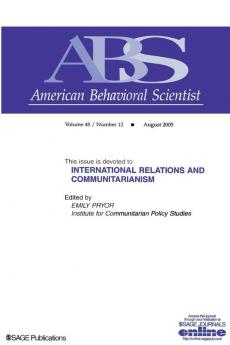
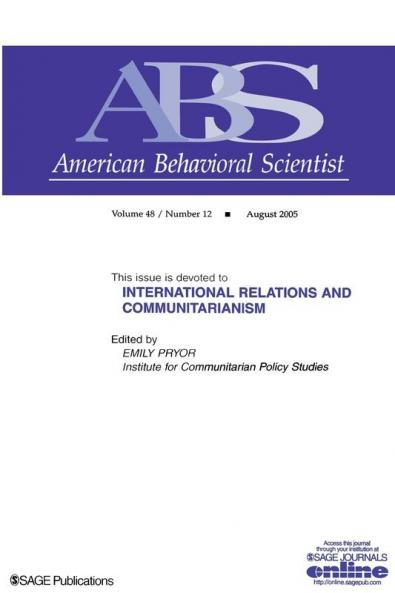
<p>Communitarianism is an intriguing social theory that states community and the social bonds of family traditional values and education are the main building blocks of a new supranational global order.&nbsp; One of its strongest proponents Amitai Etzioni posits that&nbsp; the transnational threats facing humankind today are so overwhelming that soon all nations will experience a convergence of values and priorities which will lay the groundwork for eventual global governance. The eight articles presented by the August 2005 issue of <strong>American Behavioral Scientist</strong> offer a fascinating and spirited dialogue regarding the concurrences and contradictions of communitarianism within the context of international relations. They tackle a range of topics first addressed in Etzioni's treatise <em>From Empire to Community: A New Approach to International Relations</em> including:</p><ul><li>Evaluating the European Union as a test case for communitarianism (<em>Goldgeier</em>) <li>How communitarianism predicts that U.S. hegemony will be transcended and how this fits in with the U.S.' particularly the Bush administration's grand strategy (<em>Hentz</em>) <li>Does Etizioni's nationalistic approach to U.S. foreign policy negate communitarianism's ethical problem-solving framework? (<em>Falk</em>) <li>Communitarian Realism and the emergence of common norms through coping with global challenges (<em>Gvosdev</em>) <li>The four fatal flaws of Communitarianism (<em>Gray</em>) <li>Whether sustainable economic or political integration is possible without global social assimilation taking place (<em>Müllerson</em>) <li>Etzioni's Response including a quick summary of&nbsp; the communitarian paradigm (<em>Etzioni</em>) <li>A call by Ambassador Max M. Kampelman to bolster international community through the elimination of all nuclear weapons the establishment of a national voluntary Civilian Conservation Corps for 18-21 year olds and the creation of a new education incentive along the lines of the Roosevelt G.I. Bill of Rights.</li></ul><p>This issue offers a balanced view of&nbsp; a much-disputed theory and belongs in the library of every political scientist sociologist and everyone interested in the state of the world around them.</p>

Piracy-free

Assured Quality

Secure Transactions

Fast Delivery

Sustainably Printed
Details
ISBN 13
9781412938037
Publication Date
-20-07-2005
Pages
-154
Weight
-218 grams
Dimensions
-152x229x8.38 mm
