

English



Paperback
₹891
₹990
10% OFF
(All inclusive*)
Delivery Options
Please enter pincode to check delivery time.
*COD & Shipping Charges may apply on certain items.
Review final details at checkout.
Looking to place a bulk order? SUBMIT DETAILS
Delivery Options
Please enter pincode to check delivery time.
*COD & Shipping Charges may apply on certain items.
Review final details at checkout.
About The Book
Description
Author
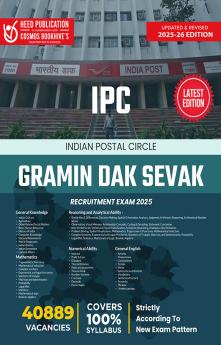
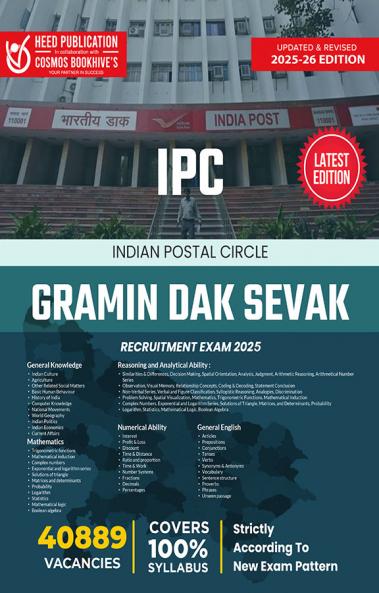
The IPC Gramin Dak Sevak (GDS) Book is a specialized guide designed for candidates preparing for the Indian Post Gramin Dak Sevak exam. The Gramin Dak Sevak is an essential role in rural postal services where individuals are responsible for delivering mail managing postal services in rural areas and providing various other postal-related services to the public.This book is tailored to help candidates understand the entire syllabus prepare thoroughly for the exam and increase their chances of success in the highly competitive recruitment process for Gramin Dak Sevak posts.Key Features of the IPC Gramin Dak Sevak Book1. Detailed Syllabus BreakdownThe book offers a comprehensive breakdown of the Gramin Dak Sevak exam syllabus which typically includes the following sections:General Knowledge (Current Affairs National and International News Geography History)Mathematics (Basic arithmetic data interpretation percentage average ratio and proportion)English Language (Grammar vocabulary sentence formation comprehension)Reasoning (Logical reasoning analytical reasoning puzzles patterns)Computer Knowledge (Basics of computer usage operating systems internet and postal software)General Awareness (Basic knowledge of the postal system services and general national issues)2. General Knowledge and AwarenessThe General Knowledge (GK) section plays a vital role in the exam. It covers:Current Affairs (National and International news recent events government schemes and policies)Indian History (Ancient medieval and modern history)Geography (Physical and political geography of India world geography)Indian Economy (Economic policies national income and important government schemes)General Science (Basic concepts of biology physics chemistry and environmental science)Indian Constitution (Structure fundamental rights and duties)3. MathematicsThe Mathematics section tests candidates' understanding of basic mathematical concepts. Topics include:Arithmetic (Addition subtraction multiplication and division)Percentages (Calculations related to profit and loss interest etc.)Ratio and Proportion (Solving problems based on ratios)Data Interpretation (Analyzing and interpreting data from tables and charts)Average (Calculating averages and solving related problems)Time and Work (Time taken for completing a task work efficiency)4. English LanguageThe English Language section assesses the candidates’ proficiency in English. Key areas include:Grammar (Parts of speech sentence construction tenses active/passive voice)Vocabulary (Synonyms antonyms and commonly used words)Comprehension (Understanding passages and answering related questions)Sentence Correction (Identifying and correcting errors in sentences)Fill in the Blanks (Complete sentences with appropriate words)Idioms and Phrases (Understanding and usage)5. Reasoning AbilityThe Reasoning Ability section tests logical thinking and problem-solving skills. This includes:Analytical Reasoning (Series completion analogy and deduction)Verbal Reasoning (Syllogism blood relations directions coding-decoding)Non-Verbal Reasoning (Image patterns mirror images and figure analysis)Puzzles (Logical puzzles seating arrangements)Data Sufficiency (Identifying whether provided data is sufficient to answer a question)6. Computer KnowledgeBasic knowledge of computers is required for the Gramin Dak Sevak role. This includes:Basic Computer Awareness (Types of computers input/output devices)Operating Systems (Windows Linux Mac OS)Internet Basics (Web browsers search engines email and online communication)Software (Basic knowledge of common software like Microsoft Office Adobe Reader)Postal Software (Understanding software used in the postal system for tracking and managing deliveries)7. Practice Questions and Mock TestsThe book includes practice questions for each section to help candidates assess their knowledge and understanding of the topics.Topic-wise Practice (Specific practice sets for mathematics English reasoning and computer knowledge)Mock Tests (Simulated exams to help candidates practice under real exam conditions)Previous Year Papers (Questions from previous years to help candidates understand the pattern and frequently asked questions)8. Time Management and Study TipsThe book provides expert time management strategies to help candidates maximize their study sessions and stay focused on important topics.Study Schedules (Effective plans to allocate study time for each subject)Exam Tips (Tips on how to approach the exam manage time and solve questions quickly and accurately)9. Interview Preparation (If Applicable)After clearing the written exam candidates may be called for an interview. The book provides helpful tips on:Interview Techniques (How to handle common questions communicate effectively and display confidence)Personality Development (How to improve your personal presentation body language and communication skills)

Piracy-free

Assured Quality

Secure Transactions

Fast Delivery

Sustainably Printed
Details
ISBN 13
9785065732707
Publication Date
-11-02-2025
Pages
-1144
Weight
-1017 grams
Dimensions
-139.7x215.9x44.72 mm
