

English


Paperback
₹6824
(All inclusive*)
Delivery Options
Please enter pincode to check delivery time.
*COD & Shipping Charges may apply on certain items.
Review final details at checkout.
Looking to place a bulk order? SUBMIT DETAILS
Delivery Options
Please enter pincode to check delivery time.
*COD & Shipping Charges may apply on certain items.
Review final details at checkout.
About The Book
Description
Author
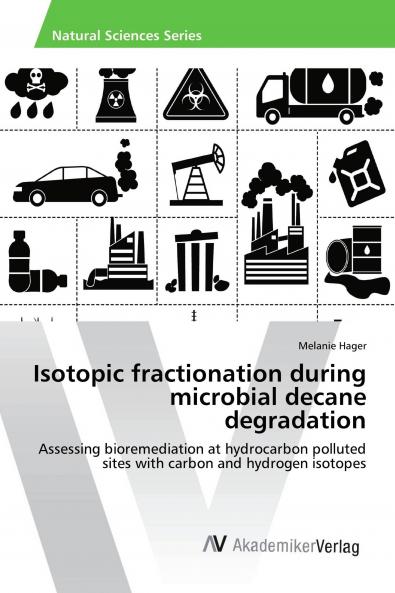
Groundwater from a diesel fuel-contaminated site in Vienna Austria was treated in pilot-scale subsurface flow constructed wetlands. The study aims at quantifying the contribution of biodegradation to the total removal of diesel compounds by means of compound-specific isotope analysis (CSIA). This innovative approach requires a constant isotope fractionation during the microbial transformation reaction which leads to an enrichment of the heavy isotopes i. e. 13C and 2H in the remaining pollutant. Filter material and/or groundwater was incubated in laboratory microcosms and the aerobic degradation of n-decane which was chosen as model compound for diesel hydrocarbons was monitored. Isotope fractionation was absent in water saturated microcosms because only minor n-decane biodegradation took place. During n-decane biodegradation in moist filter material on the other hand small but variable isotopic fractionation factors were found. The different experimental set-ups give indications how mass transfer limitations of hydrophobic molecules might mask isotopic fractionation and the consequences for field applications of CSIA are discussed in detail.

Piracy-free

Assured Quality

Secure Transactions

Fast Delivery

Sustainably Printed
Details
ISBN 13
9783330502697
Publication Date
-07-09-2016
Pages
-192
Weight
-255 grams
Dimensions
-150x220x10.46 mm
