


English





Hardback
₹3396
₹6723
49.49% OFF
(All inclusive*)
Delivery Options
Please enter pincode to check delivery time.
*COD & Shipping Charges may apply on certain items.
Review final details at checkout.
Looking to place a bulk order? SUBMIT DETAILS

Piracy-free

Assured Quality

Secure Transactions
About The Book
Description
Author
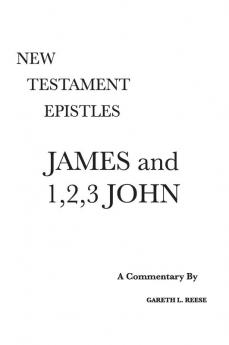
<p>This is a phrase-by-phrase commentary and exposition of the New Testament books of <em>James </em>and<em> 123 John</em>. &nbsp;This commentary is in use as a college textbook yet is suitable for the lay church member.</p><p><em>James</em> and <em>1 John</em> are written as epistles to Christians in general (i.e. not as letters to a particular church in Rome or Ephesus).&nbsp; Both were written by apostles we encounter often in the pages of the New Testament; both are men who played large roles in the life of the early Church.&nbsp; Each of these four epistles is unique within the New Testament canon and each raises issues of interest and importance for our Christian faith and practice:</p><ul> <li>The faultless roadmap for practical Christian living provided by the great spiritual principles taught by our Lord and Savior.</li> <li>The imperative need to receive the witness of God as given in Scripture through Jesus and His apostles.</li> <li>The fact that we have not followed myths when we embrace the doctrine of the powerful coming of our Lord Jesus Christ God&rsquo;s Son into the world to save sinners.</li> <li>The nature of true Christian fellowship &ndash; its exclusivity Godward and the kind of lifestyle it demands.</li> <li>How believers can <em>know</em> &ndash; by experience &ndash; the fact of their salvation.</li> <li>The loving way to counteract religious error.</li> <li>How Christians are to respond to those leaving the church.</li> <li>The parallels between 1<sup>st</sup>/2<sup>nd</sup> century Gnosticism and the pluralism and New Age theology of our 21<sup>st</sup> century.</li></ul><p>This commentary is conservative and evangelical Christian in its outlook yet skillfully examines the Scriptures from multiple theological viewpoints. &nbsp;<em>Introductory Studies</em> cover authorship and attestation the place and date of writing original target audience to whom the letters were addressed and the original purpose for writing. &nbsp;The <em>Introductory Studies</em> also discuss questions raised about these epistles by recent higher criticism &ndash; e.g. the relationship of James&rsquo; theology to Paul&rsquo;s the nature of the Gnosticism addressed in John&rsquo;s epistles the theory of a Johannine community and its role (if any) in compiling epistles and our ability to accurately reconstruct the life-setting of the 1<sup>st</sup> century Christianity which gave rise to each of these writings.&nbsp; Additionally several <em>Special Studies</em> address important topics germane to these epistles.</p><p>Since this commentary presumes the God-inspired nature of all Biblical writing the author seeks to harmonize the teachings of <em>James </em>and<em> 123 John</em> with other relevant Scriptures and also helpfully examines the original language in which the epistles were written.&nbsp; A fully annotated bibliography of other commentaries on <em>James </em>and<em> 123 John</em> is included to encourage readers to extend their own studies.</p><p>This commentary continues the author&#39;s series on the books of the New Testament and is written from the unique standpoint of the Restoration Movement a position which allows him to approach Scripture with no special theological doctrine or dogma to defend and explicate. &nbsp;This approach provides an unhindered freedom to listen to what the Holy Spirit would tell us within the pages of the sacred Scriptures. &nbsp;By deliberately employing the time-honored grammatico-historical method of interpretation the Word of God is allowed to impress upon our minds the intent the Divine Author had in mind.</p><p>The author is Professor Emeritus of the New Testament at Central Christian College of the Bible (Moberly MO).</p>
Piracy-free
Assured Quality
Secure Transactions
Delivery Options
Please enter pincode to check delivery time.
*COD & Shipping Charges may apply on certain items.
Review final details at checkout.
Details
ISBN 13
9780971765269
Publication Date
-01-02-2019
Pages
-764
Weight
-1433 grams
Dimensions
-178x254x41.28 mm
