


English


Paperback
₹1298
₹1398
7.15% OFF
(All inclusive*)
Delivery Options
Please enter pincode to check delivery time.
*COD & Shipping Charges may apply on certain items.
Review final details at checkout.
Looking to place a bulk order? SUBMIT DETAILS

Piracy-free

Assured Quality

Secure Transactions
About The Book
Description
Author
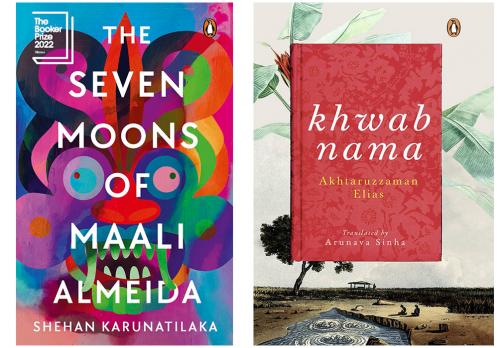
This combo product is bundled in India but the publishing origin of this title may vary.Publication date of this bundle is the creation date of this bundle; the actual publication date of child items may vary.WINNER OF THE 2022 BOOKER PRIZE . A searing satire set amid the murderous mayhem of Sri Lanka beset by civil war . Colombo 1990. Maali Almeida war photographer gambler and closet gay has woken up dead in what seems like a celestial visa office. His dismembered body is sinking in the Beira Lake and he has no idea who killed him. At a time when scores are settled by death squads suicide bombers and hired goons the list of suspects is depressingly long as the ghouls and ghosts who cluster around him can attest. But even in the afterlife time is running out for Maali. He has seven moons to try and contact the man and woman he loves most and lead them to a hidden cache of photos that will rock Sri Lanka. Ten years after his prizewinning novel Chinaman established him as one of Sri Lanka's foremost authors Karunatilaka is back with a rip-roaring epic full of mordant wit and disturbing truths.I would have considered myself blessed if I could have achieved a fraction of his quality in my writing - Mahasweta DeviBengal in the 1940s. Having overcome the famine and the revolt of the sharecroppers Bengal's peasants are uniting. Work is scarce and wages are low. There is barely any food to be had. The proposal for the formation of Pakistan the elections of 1946 and communal riots are rewriting the contours of history furiously. Amidst all this in an unnamed village a familiar corporeal spirit plunges into knee-deep mud. This is Tamiz's father the man in possession of Khwabnama.At first glance Khwabnama is the tale of a harmless young farmhand who becomes a sharecropper and dreams of a future that has everything to do with the land that he cultivates and the soil that he tills. The fabric of his dreams though have as much to do with the history ofthe land as its future and as much to do with memories as with hope.In this magnum opus which documents the Tebhaga movement wherein peasants demanded two-thirds of the harvest they produced on the land owned by zamindars Akhtaruzzaman Elias has created an extraordinary tale of magical realism blending memory with reality legend with history and the struggle of marginalized people with the stories of their ancestors. Review 'Akhtaruzzaman Elias would have been the toast of the global literary world had he been an English Spanish German or French writer' -- Imdadul Haq Milan'I would have considered myself blessed if I could have achieved a fraction of his quality in my writing' -- Mahasweta DeviThis is a worthy addition to the profusion of translations that are bursting forth from the subcontinent's rich cache of literarture... At one level the work is the tale of peasants eking out their living or attempting to do so but its folk mythology overlaid with hardcore politics gives the novel great depth. ―Deccan HeraldKhwabnama by Akhtaruzzaman Elias translated by Arunava Sinha is a beautiful mosaic of magical realism lyrical poetry and prose that captures the politics of majoritarianism that wreaks havoc on the lives of the common men and women. ―The Sunday GuardianA majestic celebration of the cultural diversity of the subcontinent. ―OpenSet in 1940s Bengal this novel tells a story of inequity and the revolution that hunger necessitates. ―India Today About the Author Akhtaruzzaman Elias (1943-97) was a Bangladeshi novelist and short-story writer who despite writing only two novels is regarded by most critics as being part of the pantheon of great Bengal authors. Chilekothar Sepai (1987) detailed the psychological journey of a man during the turbulent period just prior to Bangladeshi independence in 1971 and offered an unrivalled depiction of life in Puran Dhaka an old town. Khwabnama (1996) depicts the sociopolitical scene in the rural pre-partition Bangladesh. His many awards include the Bangla Academy Award for Literature (1983) the Kazi Mahbubullah Gold Medal (1996) and the Ekushey Padak (posthumously 1999).Arunava Sinha translates fiction poetry and non-fiction from Bengali to English and from English to Bengali. Over sixty of his translations have been published so far and several of them have won or been shortlisted for Indian and international awards.
Piracy-free
Assured Quality
Secure Transactions
Delivery Options
Please enter pincode to check delivery time.
*COD & Shipping Charges may apply on certain items.
Review final details at checkout.
Details
ISBN 13
2409160003700
Publication Date
-16-09-2024
Pages
-952
Weight
-844 grams
Dimensions
-139.7x216x56.29 mm
