


English



Paperback
₹8649
₹11515
24.89% OFF
(All inclusive*)
Delivery Options
Please enter pincode to check delivery time.
*COD & Shipping Charges may apply on certain items.
Review final details at checkout.
Looking to place a bulk order? SUBMIT DETAILS

Piracy-free

Assured Quality

Secure Transactions
About The Book
Description
Author
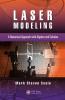
<p>Offering a fresh take on laser engineering <b>Laser Modeling: A Numerical Approach with Algebra and Calculus </b>presents algebraic models and traditional calculus-based methods in tandem to make concepts easier to digest and apply in the real world. Each technique is introduced alongside a practical solved example based on a commercial laser. Assuming some knowledge of the nature of light emission of radiation and basic atomic physics the text:</p><ul> <p> </p> <li>Explains how to formulate an accurate gain threshold equation as well as determine small-signal gain</li> <li>Discusses gain saturation and introduces a novel pass-by-pass model for rapid implementation of what if? scenarios</li> <li>Outlines the calculus-based Rigrod approach in a simplified manner to aid in comprehension</li> <li>Considers thermal effects on solid-state lasers and other lasers with new and efficient quasi-three-level materials</li> <li>Demonstrates how the convolution method is used to predict the effect of temperature drift on a DPSS system</li> <li>Describes the technique and technology of Q-switching and provides a simple model for predicting output power</li> <li>Addresses non-linear optics and supplies a simple model for calculating optimal crystal length</li> <li>Examines common laser systems answering basic design questions and summarizing parameters</li> <li>Includes downloadable Microsoft® Excel™ spreadsheets allowing models to be customized for specific lasers </li> </ul><p>Don’t let the mathematical rigor of solutions get in the way of understanding the concepts.<b> Laser Modeling: A Numerical Approach with Algebra and Calculus </b>covers laser theory in an accessible way that can be applied immediately and numerically to real laser systems.</p>
Piracy-free
Assured Quality
Secure Transactions
Delivery Options
Please enter pincode to check delivery time.
*COD & Shipping Charges may apply on certain items.
Review final details at checkout.
Details
ISBN 13
9781138071995
Publication Date
-29-03-2017
Pages
-274
Weight
-393 grams
Dimensions
-155.96x233.93x14.68 mm
