


English


Paperback
₹3775
(All inclusive*)
Delivery Options
Please enter pincode to check delivery time.
*COD & Shipping Charges may apply on certain items.
Review final details at checkout.
Looking to place a bulk order? SUBMIT DETAILS

Piracy-free

Assured Quality

Secure Transactions
About The Book
Description
Author
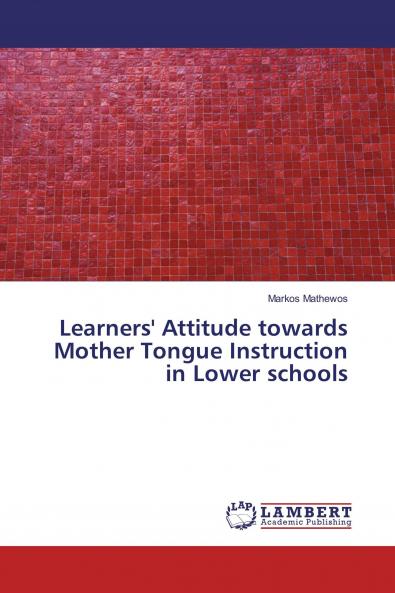
The success of a mother tongue instruction policy depends on people’s attitudes towards the first language and English L2. And to understand how attitudes towards a language develop it is necessary to consider the social and political history of a nation since such historical forces play a significant role (Bamgbose 1991; Robinson 1996). Thus the colonial and the post-colonial language and educational policies obviously provide a solid basis of the explanation of attitudes towards African languages and English L2 (Ngugi wa Thiongo 1986; Bamgbose 1991; Roy- Campbell 1996; Adegbija 1994; Robinson 1996). Attitudes can be created through functions that people perceive particular languages as performing. In the African context Robinson (1996) is of the opinion that official and local languages are regarded as opposed to each other rather than as complementary as evidenced by the fact that one of the two languages may be regarded as a more suitable language for certain domains and the characteristic functions are seen in dichotomous terms.
Piracy-free
Assured Quality
Secure Transactions
Delivery Options
Please enter pincode to check delivery time.
*COD & Shipping Charges may apply on certain items.
Review final details at checkout.
Details
ISBN 13
9786134953535
Publication Date
-18-01-2018
Pages
-76
Weight
-111 grams
Dimensions
-150x220x4.5 mm
