

English


Paperback
₹9243
(All inclusive*)
Delivery Options
Please enter pincode to check delivery time.
*COD & Shipping Charges may apply on certain items.
Review final details at checkout.
Looking to place a bulk order? SUBMIT DETAILS

Piracy-free

Assured Quality

Secure Transactions
About The Book
Description
Author
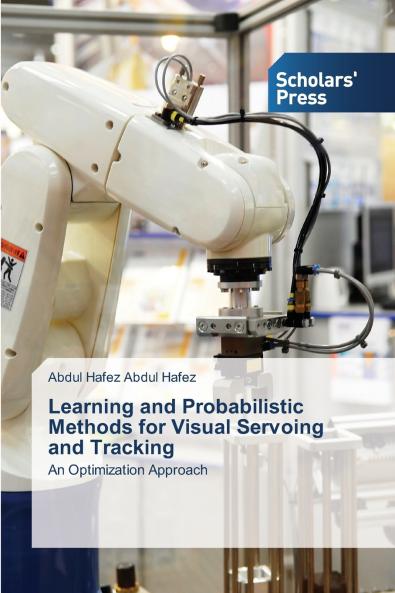
The long term dream of robotic research is to develop systems with the abilities to carry out tasks in highly complex and dynamic everyday environments like home or office. To realize this dream it is important to improve the sensory capabilities of the robots. Vision has proved to be the most versatile sensor for robotic applications. Computer vision algorithms have successfully been used to control a variety of dynamic systems including manipulator arms mobile robots autonomous and underwater vehicles. Using visual feedback to close the control loop of robot arm is now referred to as visual servoing. Visual tracking in image sequences is an important topic of research in visual servoing and general robot vision applications. Robust extraction and real-time visual tracking of visual cues is indeed one of the keys to success of a visual servoing task. This book presents visual servoing and tracking algorithms based on probabilistic and learning techniques. First different types of information 2D and 3D are integrated in the feature space and action space. Second visual tracking algorithms are presented to provide visual feedback via robust visual cues.
Piracy-free
Assured Quality
Secure Transactions
Delivery Options
Please enter pincode to check delivery time.
*COD & Shipping Charges may apply on certain items.
Review final details at checkout.
Details
ISBN 13
9783639719208
Publication Date
-30-06-2014
Pages
-236
Weight
-326 grams
Dimensions
-150x220x12.72 mm
