



by
John Lok
English










Paperback
₹990
₹1466
32.47% OFF
(All inclusive*)
Delivery Options
Please enter pincode to check delivery time.
*COD & Shipping Charges may apply on certain items.
Review final details at checkout.
Looking to place a bulk order? SUBMIT DETAILS
Delivery Options
Please enter pincode to check delivery time.
*COD & Shipping Charges may apply on certain items.
Review final details at checkout.
About The Book
Description
Author
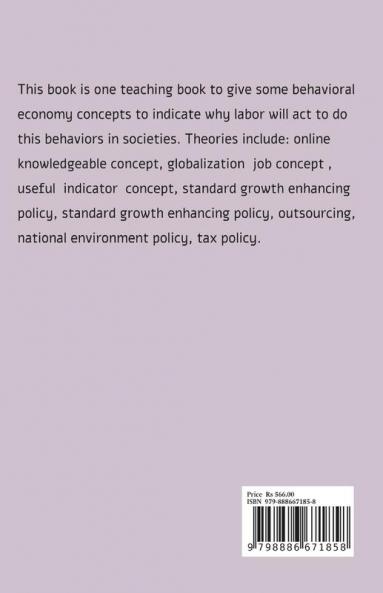
<p>Insights from Behavioral EconomicsThe implementation of effective management strategy particularly through the lens of behavioral economics as explored by my view requires a fundamental shift from traditional rational actor models toward an understanding of human psychology social norms and cognitive biases.</p><p>Management science as detailed in foundational texts emphasizes that organizational success is not merely a product of quantitative optimization but is deeply rooted in the behavioral architecture of the workplace.By integrating behavioral insights managers can design systems that align individual motivations with organizational objectives moving beyond simple monetary incentives to foster sustainable performance.</p><p>Humans are inherently social creatures who derive cues for appropriate behavior from their peers.In a management context this means that transparency regarding majority behavior can significantly influence employee output and adherence to standards.For instance when managers share anonymized data regarding performance benchmarks or conservation efforts they trigger a social comparison mechanism that encourages individuals to align with the group average or strive for the top tier. This creates a self-regulating environment where peer pressure-rather than top-down enforcement-drives efficiency.<br/> </p>

Piracy-free

Assured Quality

Secure Transactions

Fast Delivery

Sustainably Printed
Details
ISBN 13
9798886671858
Publication Date
-11-04-2022
Pages
-346
Weight
-470 grams
Dimensions
-152.4x228.6x18.38 mm
