


English



Hardback
₹11458
₹13561
15.51% OFF
(All inclusive*)
Delivery Options
Please enter pincode to check delivery time.
*COD & Shipping Charges may apply on certain items.
Review final details at checkout.
Looking to place a bulk order? SUBMIT DETAILS
Delivery Options
Please enter pincode to check delivery time.
*COD & Shipping Charges may apply on certain items.
Review final details at checkout.
About The Book
Description
Author(s)
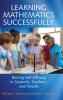
<p>The goal of this book is to bring together the concept of self-efficacy theory with practical how-to strategies for both teachers and parents to use in heightening their students&rsquo; levels of self-efficacy. The book examines how&nbsp;&nbsp;&nbsp;&nbsp;&nbsp; self-efficacy theory relates to the acquisition of mathematical competence. The text also provides specific and practical how-to strategies for both teachers and parents in applying these principles to classroom mathematics instruction and activities. The self-efficacy practices and applications to mathematics are also suitable for families working with learners outside the school environment.&nbsp;&nbsp;&nbsp;&nbsp;&nbsp;&nbsp;&nbsp;&nbsp;&nbsp;&nbsp;&nbsp;&nbsp;&nbsp;&nbsp;&nbsp;&nbsp;&nbsp;&nbsp;&nbsp;&nbsp;&nbsp;&nbsp;&nbsp;&nbsp;</p><p>Acquiring mathematical skills requires more than knowing arithmetic tables memorizing rules and knowing proofs. It requires a basic belief that one is capable of obtaining this information making sense of it and applying and generalizing it in mathematical problems. In addition a student must believe that obtaining these skills leads to a positive outcome whether it is perceived to be a good or passing grade comfort-level in tackling mathematical problems being able to advance to the next mathematics course being able to score highly on the math section of the SAT and/or be competitive for a desired job.</p><p>The ability of students to achieve and exceed grade level competence in mathematics is addressed through the lens of Albert Bandura&rsquo;s Self-Efficacy Theory. This&nbsp; theoretical position states that one will persist in mastering a behavior (in this case mastering mathematical principles and skills) in the face of obstacles or failures&mdash;to the extent that one believes he or she has the ability to do so and that there is a desired outcome for doing so. The research literature on the role of self-efficacy in mathematic instruction is examined to demonstrate the validity of using this concept to increase student (and parent/teacher) confidence in learning and applying grade-appropriate math content. Specific teaching methodologies will be provided that infuse self-efficacy strategies for students. Lastly teachers and parents are provided strategies to increase their own self-efficacy when it comes to conveying mathematics principles to their child or student as well as strategies to assess their students&rsquo; level of self-efficacy over time.</p><p>Teaching and learning mathematics so that students achieve success at their grade level or above can present a variety of challenges. One barrier that affects learners is the belief that one is not capable of learning mathematics or not naturally talented in the field not a &ldquo;math person.&rdquo;&nbsp; As a result learners may not believe they are capable of a positive outcome for achieving mathematics success.&nbsp;This book is an important resource for pre-service and in-service teachers as well as families in applying the theory of self-efficacy to support learners in becoming confident and assured in their ability to understand and apply mathematical principles and procedures.&nbsp;Coupled with classroom ready mathematics instructional strategies the book provides readers with the background tools and strategies&nbsp;needed to carry content success and&nbsp;and confidence forward to remain persistent in solving all future mathematical problems.</p>

Piracy-free

Assured Quality

Secure Transactions

Fast Delivery

Sustainably Printed
Details
ISBN 13
9781641137386
Publication Date
-19-09-2019
Pages
-198
Weight
-381 grams
Dimensions
-156x234x12.7 mm
