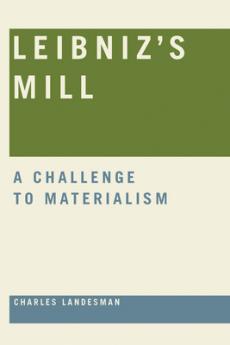
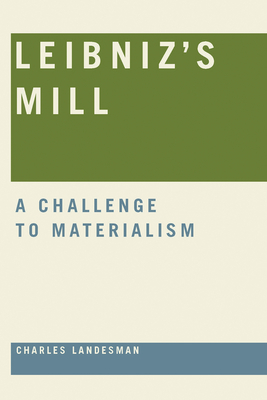
Leibniz's Mill

About The Book

<p>The title of this book <i>Leibniz's Mill</i> is taken from Leibniz's famous metaphor in support of a dualism between the mind or self and the body. Given that Descartes constructed the most famous defense of mind/body dualism the first chapter is a basic exposition and defense of Descartes' arguments as well as Leibniz's supporting argument. Charles Landesman's basic claim argued with clarity and philosophical precision is that dualism is to be preferred to materialism; namely the self is not reducible to the body mental processes are not reducible to brain processes and the idea that the self is a mental substance constitutes the best understanding of all the facts of mental life. </p><p>Landesman takes up the central philosophical topics on the nature of the self and the mind in arguing that dualism is a defensible position even if our mental life is dependent in some respects on the body. Dependency is not the same as identity. Nor should one deny that many bodily events are dependent upon states of mind. He examines our knowledge of other minds the mind's knowledge of itself and Descartes' famous argument I think therefore I am; efforts by philosophers such as Hume Nietzsche William James Whitehead Wittgenstein and Heidegger to deny the reality of a substantial ego; the mind's way of knowing of the physical world with its great deception of sense; and finally the teleological structure of human action and the problem of free will. Landesman argues that the dualism of mind and body is perfectly compatible with modern science and that contrary to the claims of many philosophers there is no reason to hold that science presupposes a naturalistic or materialistic framework.</p>
Piracy-free
Piracy-free
Assured Quality
Assured Quality
Secure Transactions
Secure Transactions
Delivery Options
Please enter pincode to check delivery time.
*COD & Shipping Charges may apply on certain items.
Review final details at checkout.
downArrow

Details


LOOKING TO PLACE A BULK ORDER?CLICK HERE