

English




Hardback
₹17032
₹19768
13.84% OFF
(All inclusive*)
Delivery Options
Please enter pincode to check delivery time.
*COD & Shipping Charges may apply on certain items.
Review final details at checkout.
Looking to place a bulk order? SUBMIT DETAILS
Delivery Options
Please enter pincode to check delivery time.
*COD & Shipping Charges may apply on certain items.
Review final details at checkout.
About The Book
Description
Author
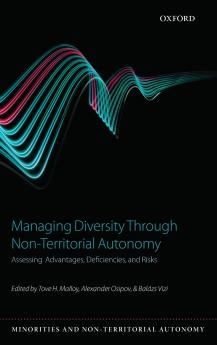
Non-territorial autonomy (NTA) is a statecraft tool that is increasingly gaining importance in societies seeking to accommodate demands by ethno-cultural groups for a voice in cultural affairs important to the protection and preservation of their identity such as language education and<br>religion. As states recognize the specific rights of identity minorities in multicultural and multi-ethnic societies they are faced with a need to improve their diversity management regimes. NTA offers policy-makers a range of options for institutional design adaptable to specific circumstances and<br>historical legacies. It devolves degrees of power through legal frameworks and institutions in specific areas of ethno-cultural life while maintaining social unity at the core level of society. Throughout Europe and North America NTA exists and is implemented at a state regional and local level.<br>Much has been written about the concept of autonomy and its usage as a statecraft tool in states facing regional division but little literature addresses its non-territorial institutional and public administration functions. This edited volume seeks to fill this gap. <p/><em>Managing Diversity through Non-Territorial Autonomy: Assessing Advantages Deficiencies and Risks</em> carves a space for contextual knowledge production on NTA in law as well as social and political sciences. Contextual knowledge involves a description of institutions and their functionality as well<br>as of the institutional and legal frames protecting these. What are the institutions bodies and functions that ethno-cultural groups can draw on when seeking to have a voice over their own affairs as well as over issues in society related to their identity production? How are these entities<br>incorporated and empowered to have a voice? What degree of voice do they have and how are they designed to project this voice? Thus contextual knowledge also involves critical assessment and risk analysis as well as penetrating insights as to the unintended consequences and hidden agendas that may<br>inform NTA policies. This volume is to provide both policy-makers and ethno-cultural groups with a tool-kit that promotes social cohesion while respecting diversity. <p/>This is the first volume in a series of five which will examine the protection and representation of minorities through non-territorial means.<br>

Piracy-free

Assured Quality

Secure Transactions

Fast Delivery

Sustainably Printed
Details
ISBN 13
9780198738459
Publication Date
-01-11-2015
Pages
-338
Weight
-573 grams
Dimensions
-156x234x20.64 mm
