

English


Paperback
₹1362
₹1436
5.15% OFF
(All inclusive*)
Delivery Options
Please enter pincode to check delivery time.
*COD & Shipping Charges may apply on certain items.
Review final details at checkout.
Looking to place a bulk order? SUBMIT DETAILS
Delivery Options
Please enter pincode to check delivery time.
*COD & Shipping Charges may apply on certain items.
Review final details at checkout.
About The Book
Description
Author
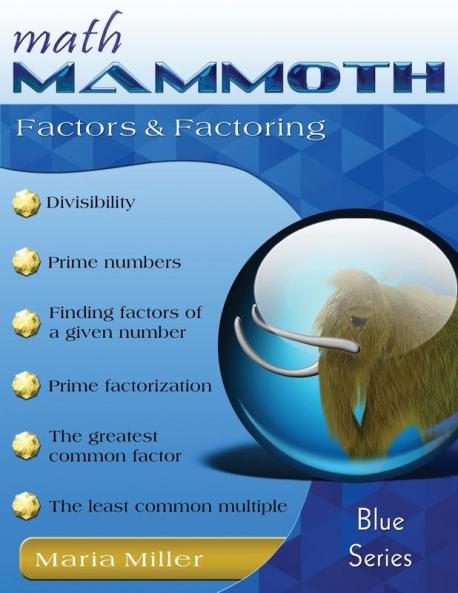
<p><em>Math Mammoth Factors &amp; Factoring</em>&nbsp;is a worktext that covers typical number theory topics for upper elementary school: divisibility rules finding factors of a given number prime numbers prime factorization the greatest common factor and the least common multiple. These topics are usually covered in grades 4-6.</p><p><br></p><p>The book begins with 4th grade topics starting out with the concept of&nbsp;<strong>divisibility and the common divisibility rules</strong>. The lesson&nbsp;<em>Prime Numbers&nbsp;</em>brings out the concept of a prime number as one that is only divisible by 1 and by itself. Armed with the knowledge about divisibility students now learn how to find factors of a given two-digit number in the lesson&nbsp;<em>Finding Factors</em>.</p><p><br></p><p>The following lesson <em>&nbsp;Primes and Finding Factors</em> is a review lesson about factors primes and divisibility rules originally intended for beginning of 5th grade. You can use it as a review of the first four lessons of this book or for students that have some knowledge of these topics already.</p><p><br></p><p>The next two lessons delve into&nbsp;<strong>prime factorization</strong>&nbsp;using a factor tree. The first lesson on the topic only uses two-digit numbers. In the latter students are introduced the sieve of Eratosthenes and they factorize three-digit and larger numbers.</p><p><br></p><p>The last topics in the book are&nbsp;<strong>the greatest common factor (GCF) the least common multiple (LCM) and factoring sums</strong> intended mainly for 6th grade. Factoring sums means writing a sum such as 42 + 18 as 6(7 + 3). We first find a common factor of 42 and 18 (which is 6) and use that to factorize the sum. The lesson only deals with numeric examples but it is actually preparing students for algebra where the same process is done with variables; for example&nbsp;<em>x</em><sup>2</sup>&nbsp;+&nbsp;2<em>x</em>&nbsp;is factored as&nbsp;<em>x</em>(<em>x</em>&nbsp;+&nbsp;2).</p><p><br></p><p>The book ends in a review lesson. Answers are appended.</p>

Piracy-free

Assured Quality

Secure Transactions
Details
ISBN 13
9781954358737
Publication Date
-29-04-2024
Pages
-58
Weight
-162 grams
Dimensions
-216x280x3.05 mm
