


English


₹8306
(All inclusive*)
Paperback
Delivery Options
Please enter pincode to check delivery time.
*COD & Shipping Charges may apply on certain items.
Review final details at checkout.
Looking to place a bulk order? SUBMIT DETAILS
Delivery Options
Please enter pincode to check delivery time.
*COD & Shipping Charges may apply on certain items.
Review final details at checkout.
About The Book
Description
Author
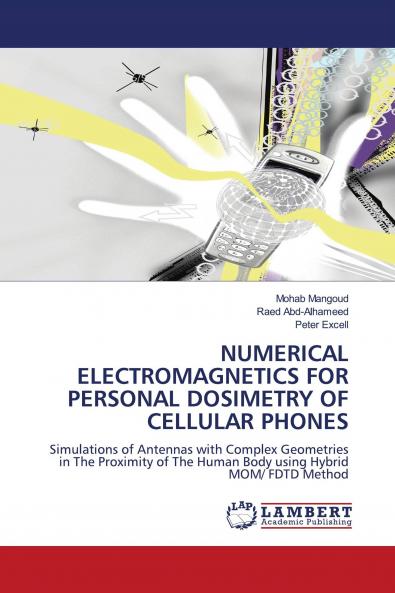
An approach to hybridisation of the Method of Moments (MoM) and the Finite Difference Time Domain (FDTD) method is investigated. This hybrid method is capable of analysing a system of multiple discrete regions by employing the principle of equivalent sources to excite their coupling surfaces. Examples are provided to indicate both the potential and limitations of the hybrid method. It is shown that this technique has the great advantage of accurately modelling complex and arbitrarily oriented mobile telephone handset antennas especially typical helical types in the proximity of a detailed voxel representation of the human head as required for safety and radiation pattern assessments. A new technique to reduce power dissipation in tissues close to mobile telephones is investigated resulting in a novel design of bifilar helical antenna. Different personal communication terminals used for satellite communications and radio base stations considered in the proximity of inhomogeneous dielectric bodies are studied illustrating strengths of using the hybrid method in such applications.

Piracy-free

Assured Quality

Secure Transactions

Fast Delivery

Sustainably Printed
Details
ISBN 13
9783843368339
Publication Date
-12-11-2010
Pages
-360
Weight
-488 grams
Dimensions
-150x220x19.09 mm
