

English


Paperback
₹4609
(All inclusive*)
Delivery Options
Please enter pincode to check delivery time.
*COD & Shipping Charges may apply on certain items.
Review final details at checkout.
Looking to place a bulk order? SUBMIT DETAILS
Delivery Options
Please enter pincode to check delivery time.
*COD & Shipping Charges may apply on certain items.
Review final details at checkout.
About The Book
Description
Author
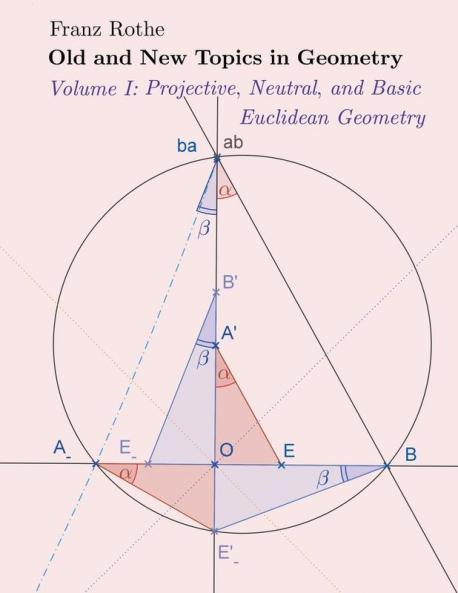
<p>The present first volume begins with Hilbert's axioms from the \emph{Foundations of Geometry}.</p><p>After some discussion of logic&nbsp;and axioms in general&nbsp;incidence geometries especially the finite ones and affine and projective geometry in two and three dimensions are treated. As in Hilbert's system there follow sections about the axioms of order and congruence in neutral geometry the axioms of measurement and of completeness and deviating from Hilbert about circles.</p><p><br></p><p>The insight of independence of the parallel axiom&nbsp;leaves many open roads to pursue</p><p>but the desire to develop a natural as well as completely axiomatic system remains.&nbsp;In this context the classification of Hilbert planes into three types---as semi-euclidean semi-elliptic or semi-hyperbolic known as the uniformity theorem&nbsp;is a important step beyond Euclid. A further step is the introduction of the axiom of the unbounded opening of an angle. In the spirit of Hilbert&nbsp;a completely axiomatic theory of area in neutral geometry is set up before branching into the cases of Euclidean or semi-hyperbolic or semi-elliptic geometry.</p><p><br></p><p>Finally the attention has to focus of Euclidean geometry. The text gets a more educational and even more elementary flavor. Here I start with Thales theorem about the angle in a semicircle and continue with Euclid's related theorems about angles in a circle.The most&nbsp;simple parts of the Euclidean geometry are given in detail as well as the later parts about similarity and&nbsp;area in Euclidean geometry with the theorem of Pythagoras and</p><p>trigonometry and finally the measurement of the circle.</p><p><br></p><p><br></p><p><br></p><p><br></p><p><br></p>

Piracy-free

Assured Quality

Secure Transactions

Fast Delivery

Sustainably Printed
Details
ISBN 13
9798887032498
Publication Date
-08-05-2023
Pages
-544
Weight
-1266 grams
Dimensions
-216x280x37.55 mm
